

Analytic Tomography Book 106
Original price was: $76.00.$38.00Current price is: $38.00.

Andrew Markoe
Product Specs:
- File Type: PDF
- File Size: 12.5 MB
- Book Language: English
- Total Page Count: 408
- Instant Download
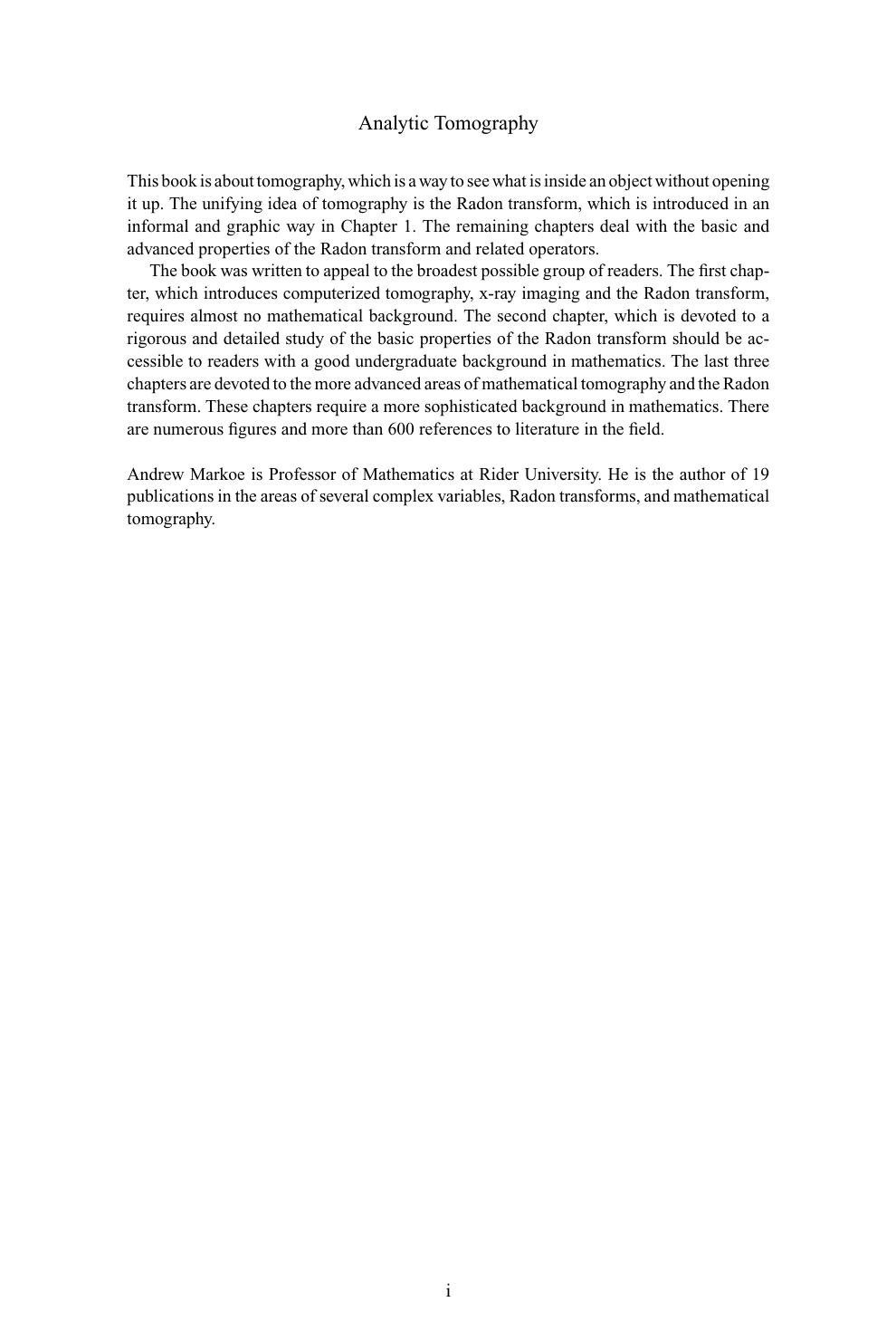
Analytic Tomography takes one of the most intriguing ideas in modern applied mathematics—seeing inside an object without opening it—and develops it with remarkable range and clarity. Andrew Markoe uses tomography as a bridge between intuition and analysis, starting with the familiar world of CT scanning and then building steadily toward the Radon transform, the k-plane transform, and several broader variants.
The result is a book that moves from visual explanation to serious mathematical structure without losing sight of the central problem: how interior information is encoded in projections, and how that information can be reconstructed. Early chapters are designed to be approachable, while later sections move into deeper territory involving range questions, differential equations, Grassmann manifolds, and related analytic tools.
From CT Images to the Radon Transform
The opening material introduces computerized tomography, x-rays, backprojection, and filtered backprojection in a way that gives readers a concrete picture of how reconstruction works in practice. That foundation makes the later theory feel anchored rather than abstract for its own sake.
A Rigorous Core for Mathematical Readers
At the center of the book is a careful study of the Radon transform itself: its properties, inversion methods, approximate identities, and the mathematical ideas that make tomography work. Readers with a background in calculus and undergraduate mathematics will find a substantial and well-motivated progression, while more advanced chapters extend the discussion into topics that will appeal especially to graduate students, analysts, and researchers.
Broad Scope, Serious Depth
Beyond the standard Radon transform, Markoe explores the k-plane transform, local tomography, uniqueness and non-uniqueness, consistency conditions, divergent beam and cone beam transforms, attenuated and exponential Radon transforms, and other generalizations. The book also points toward connections with twistor theory, the Penrose transform, and D-modules, making it especially valuable for readers who want to see tomography in a wider mathematical landscape.
Why It Stands Out
This is not a quick overview or a pop-science explanation. It is a substantial, research-informed treatment of analytic tomography, written for readers who want both the intuition and the machinery behind the subject. With extensive references and a detailed index, it works well as a serious study text and as a reference point for related work in integral geometry and imaging theory.
If your interests include tomography, the Radon transform, inverse problems, or the mathematics behind imaging, this is a distinctive and carefully structured ebook to keep close at hand.
User Reviews
Be the first to review “Analytic Tomography Book 106”
You must be logged in to post a review.
Original price was: $76.00.$38.00Current price is: $38.00.



There are no reviews yet.