

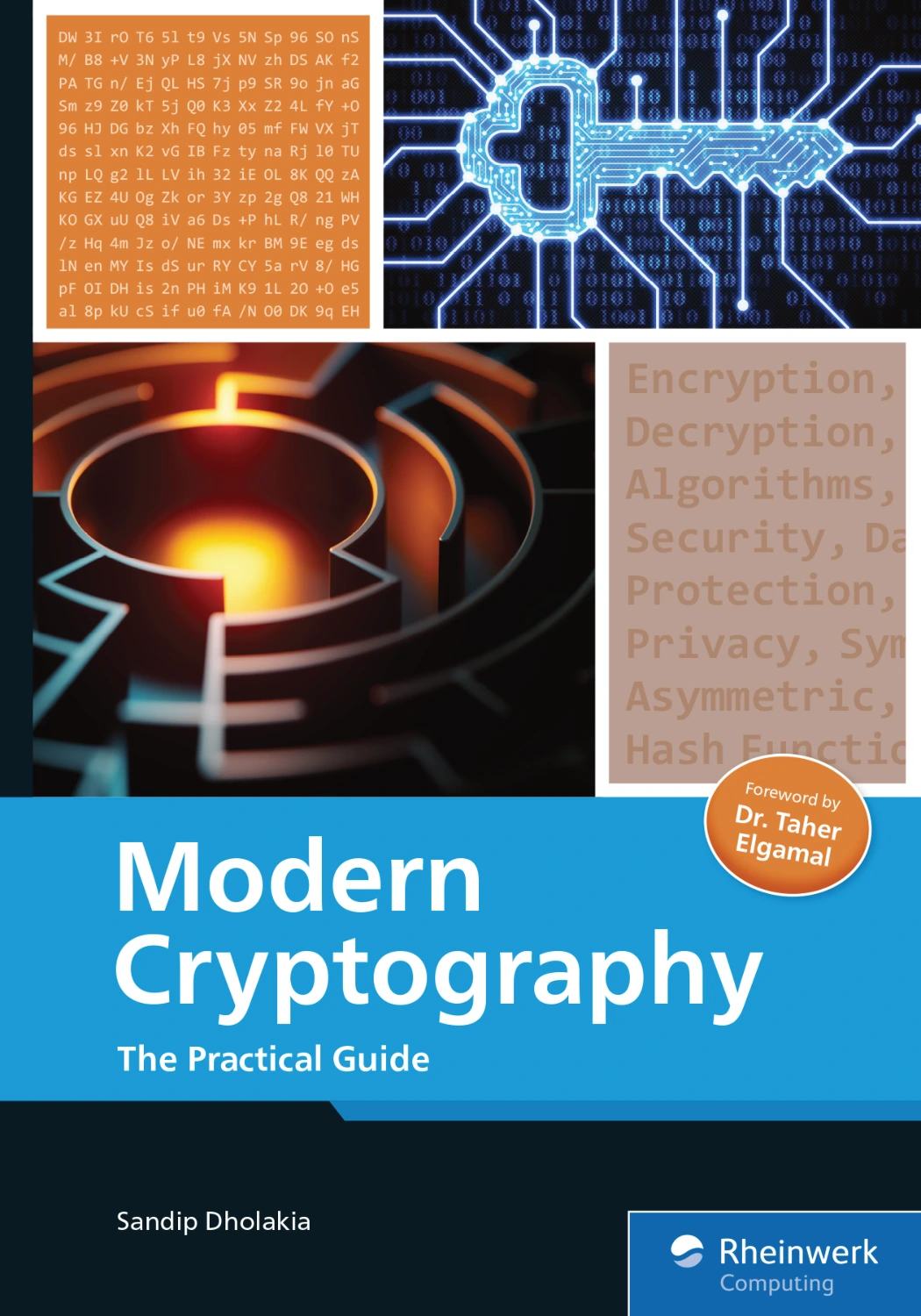
Modern Cryptography: The Practical Guide
Original price was: $5.00.$2.50Current price is: $2.50.

Sandip Dholakia
Product Specs:
- File Type: PDF
- File Size: 5.6 MB
- Book Language: English
- Total Page Count: 427
- Instant Download
Cryptography You Can Actually Deploy 🔐
Cryptography is the rare technology that works best when nobody notices it. It sits behind encrypted messages, bank transfers, cloud logins, and signed software updates — and when it is implemented badly, the failure is usually silent and expensive. Modern Cryptography: The Practical Guide is written for the people who have to get those decisions right: developers, security engineers, architects, and students preparing to work on systems that hold other people’s data.
Sandip Dholakia structures the book in two deliberate halves. The first builds the foundations. The second takes those foundations into live environments — servers, browsers, cloud tenants, connected devices, and blockchains — where theory meets configuration files and key rotation policies.
Part I: How the Algorithms Work
Before discussing deployment, the book traces where modern cryptography came from. It opens with the historical development of ciphers and a working explanation of why cryptography is required in the first place, then separates three ideas that are frequently confused: encoding, hashing, and encryption. Transposition and substitution ciphers appear early as teaching tools, alongside a mathematics refresher and a clear treatment of confusion and diffusion.
From there, the coverage moves systematically through the algorithm families that underpin contemporary security:
- Symmetric cryptography — DES, its variants and Triple DES, the International Data Encryption Algorithm, and the Advanced Encryption Standard
- Asymmetric cryptography — the properties that make public-key systems work, the introductory mathematics behind them, Diffie–Hellman–Merkle key exchange, the Elgamal cryptosystem, and elliptic curve cryptography
- Cryptographic services — hash functions, the SHA family, message digest algorithms, message authentication codes, and the Digital Signature Standard
Each algorithm is presented in context rather than as an isolated recipe, so the trade-offs between key length, performance, and resistance to attack become visible.
Part II: Cryptography in Working Systems
The second half is where the book earns its subtitle. Chapters move through the practical places encryption has to function:
- Data at rest — understanding what actually needs protecting, data security concepts, and encryption methods including application-level encryption
- Data in transit — implementing TLS, building VPNs with IPsec, securing web applications, email, streaming, and downloads, plus the public key infrastructure that makes trust possible
- Cloud and connected devices — infrastructure, data, and application security in the cloud, encryption key management, provider-managed versus customer-managed keys, cryptography services from major cloud platforms, and lightweight cryptography for the Internet of Things
- Cryptocurrency — how cryptographic transactions, wallet key management, and the algorithms used in digital currencies actually fit together
Because the same primitive can be safe in one configuration and weak in another, seeing storage, transport, and cloud examples side by side is genuinely useful. It turns abstract properties into engineering choices.
Where Cryptography Is Heading ⚛️
The closing chapters look forward rather than back. Artificial intelligence appears twice as a theme: the role AI plays in cryptographic work, and the question of how to secure AI models themselves. A substantial section is devoted to quantum computing — its history, its technologies, the specific risk it poses to widely used public-key schemes, quantum cryptography, and quantum-resistant algorithms. NIST’s post-quantum cryptography initiative is covered directly, along with practical guidance on preparing and implementing post-quantum approaches.
A final chapter introduces homomorphic encryption: its history, the different types, symmetric-key variants, and applications ranging from electronic voting to privacy-preserving machine learning. Best practices and the ethical use of these technologies are addressed along the way.
Who Will Get the Most From It
This is a technical book and does not pretend otherwise. Readers with some background in networking, software development, or IT security will move through it comfortably. Students in security or computer science programs will find the progression from primitives to systems maps well onto a semester of study. Practitioners who already deploy TLS or manage cloud keys will find the later chapters useful for filling gaps around key management, IoT constraints, and post-quantum migration planning.
What the book does particularly well is refuse to separate the mathematics from the mess. Algorithms are explained, then shown operating inside real protocols, real cloud services, and real threat models.
Start Reading
Digital Delights delivers Modern Cryptography: The Practical Guide as an instant digital download, ready to read on the device you already use. If your work touches encrypted data — and increasingly, whose does not — this is a reference worth keeping close.
User Reviews
Only logged in customers who have purchased this product may leave a review.
Original price was: $5.00.$2.50Current price is: $2.50.


There are no reviews yet.