

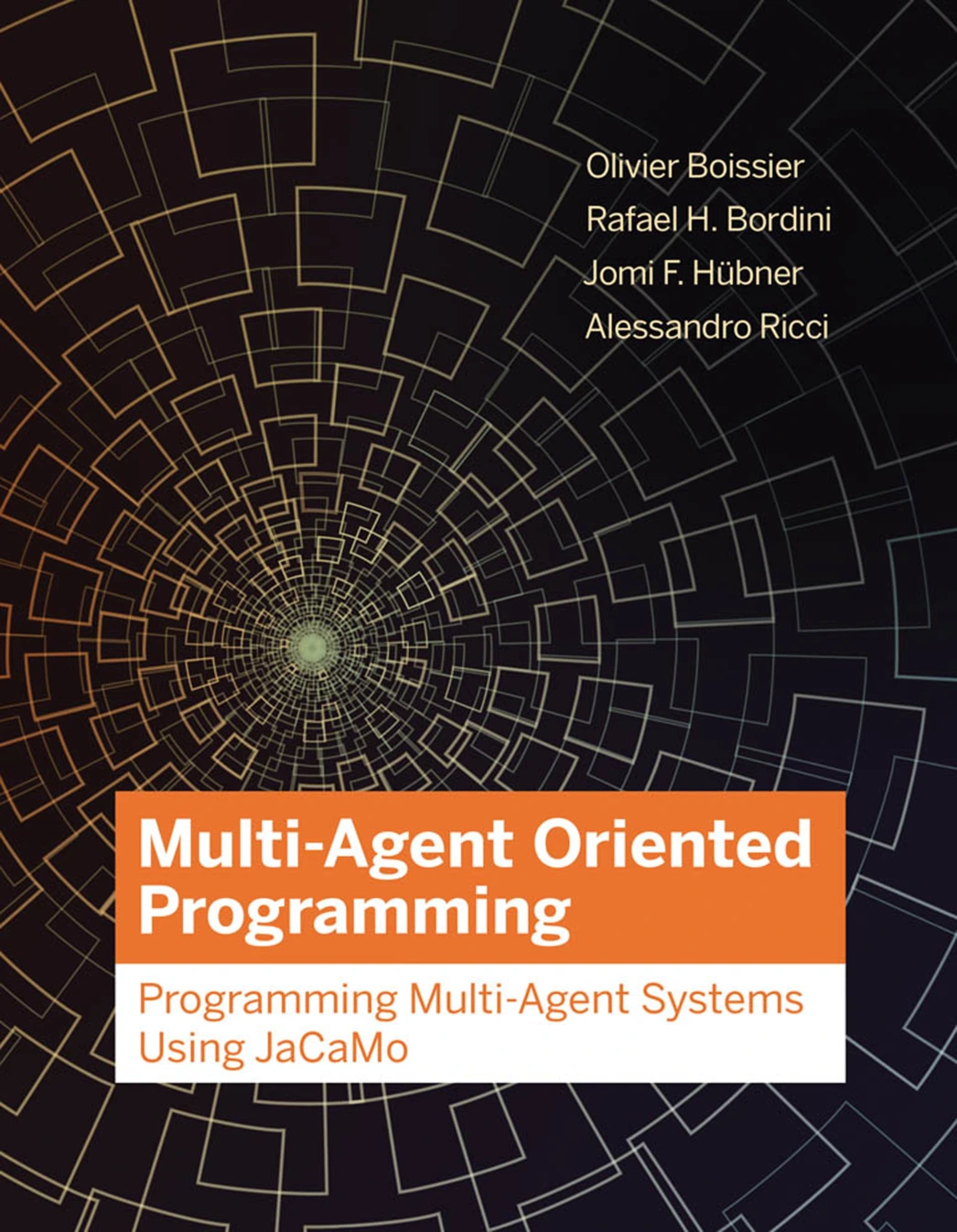
Multi-Agent Oriented Programming: Programming Multi-Agent Systems Using JaCaMo
Original price was: $5.00.$2.50Current price is: $2.50.

Olivier Boissier
Product Specs:
- File Type: PDF
- File Size: 10.7 MB
- Book Language: English
- Total Page Count: 261
- Instant Download
Many Agents, One Shared World 🤖
Multi-agent systems are not just a collection of independent programs; they are software worlds where autonomous components perceive, act, coordinate, and sometimes organize themselves. Multi-Agent Oriented Programming gives that idea a concrete programming framework. Published by The MIT Press and written by Olivier Boissier, Rafael H. Bordini, Jomi F. Hübner, and Alessandro Ricci, the book presents JaCaMo as a way to program multi-agent systems with agents, environments, and organizations as first-class building blocks.
What Makes the JaCaMo Approach Distinct ⚙️
Instead of treating coordination as an afterthought, the book develops a layered view of multi-agent programming. Agents encapsulate autonomous behavior, environments provide the shared world in which they act, and organizations describe the social and structural patterns that shape interaction. JaCaMo brings these dimensions together in a single platform, giving readers a practical way to design systems that are more than the sum of their parts.
Inside the Book: Three Programming Dimensions
- The agent dimension: how autonomous, goal-directed agents are defined and executed.
- The environment dimension: how shared resources, artifacts, and interaction spaces are modeled for agents.
- The organization dimension: how roles, groups, norms, and organizational structures coordinate agent behavior.
From Hello-World to a Smart Room 💻
The book builds steadily from a single-agent hello-world through multi-agent, environment, and organization examples. Later chapters work through a smart room scenario, adding reactivity, fault tolerance, and adaptivity. Readers then see multiple agents interacting in an environment, decentralized coordination through interaction protocols, environment-mediated coordination, and distribution. The final programming chapters explore organized smart rooms, changing organizations, agents deploying their own organization, and agents reasoning about organizational structures.
Research Corners, Technology Corners, and Exercises
Research Corners and Technology Corners connect the core material to broader ideas and practical tools, while exercises and solutions turn the book into a structured study resource. The closing chapters discuss libraries, frameworks, platforms, mainstream application domains, integration with other multi-agent system platforms, and the relationship between multi-agent oriented programming, artificial intelligence, and software engineering.
Who May Find This Book Useful
This is a serious technical volume for readers who want to understand how multi-agent systems are designed, programmed, and organized. It should appeal to students, researchers, and software professionals working with autonomous systems, distributed AI, intelligent agents, and coordination models. A background in programming and an interest in agent-based concepts will help readers get the most from the JaCaMo examples and exercises.
A Useful Bridge Between AI and Software Engineering
By treating agents, environments, and organizations as complementary programming concerns, Multi-Agent Oriented Programming offers a coherent path from theory to working code. It is both a guide to JaCaMo and a broader argument for a multi-agent oriented way of thinking about complex software systems.
User Reviews
Be the first to review “Multi-Agent Oriented Programming: Programming Multi-Agent Systems Using JaCaMo”
You must be logged in to post a review.
Original price was: $5.00.$2.50Current price is: $2.50.





There are no reviews yet.