

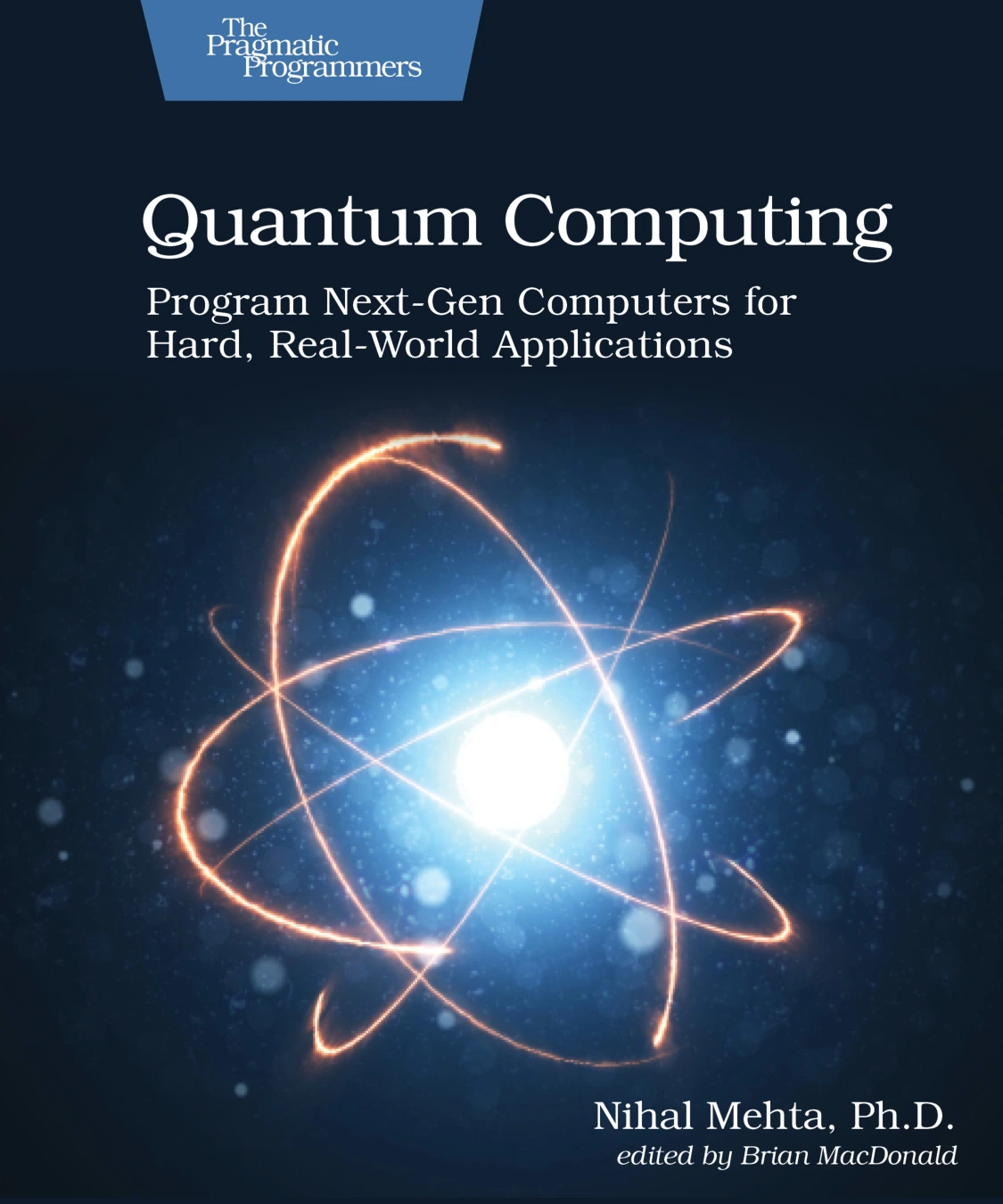
Quantum Computing: Program Next-Gen Computers for Hard, Real-World Applications
Original price was: $5.00.$2.50Current price is: $2.50.

Nihal Mehta, Ph.D
Product Specs:
- File Type: PDF
- File Size: 27.7 MB
- Book Language: English
- Total Page Count: 571
- Instant Download
Quantum Computing for Programmers Who Want to Build, Not Just Read
Quantum computing has a reputation for being strange, mathematical, and far removed from the daily work of writing software. Nihal Mehta’s Quantum Computing: Program Next-Gen Computers for Hard, Real-World Applications takes a different path. It begins with visual, intuitive models and gradually turns those ideas into the concepts and skills you need to write real quantum programs.
Published by The Pragmatic Bookshelf in 2020, this guide is built for developers and technically curious readers who want a practical understanding of what quantum computers can do—and how to program them.
Start with Qubits, Build with Qubelets
Instead of throwing equations at you from page one, the book introduces the Qubelets model to help you picture quantum bits and their behavior. You’ll explore how quantum states differ from classical bits, how measurement changes what you see, and why quantum logic gates operate in ways that can feel both elegant and counterintuitive.
From there, the material moves into the building blocks of quantum circuits, including NOT, CNOT, and CCNOT gates, logic expressions, and the step-by-step construction of quantum programs.
Superposition, Entanglement, and Quantum Logic
Superposition and entanglement are two of the most talked-about ideas in quantum computing. This book gives them a programmer’s context. You’ll work through blended states, multi-qubit superposition, tagging optimal solutions, and entanglement in practical circuits. The goal is not just to recognize the terms, but to understand how they are used inside quantum algorithms.
Algorithms, Cryptography, and Real Hardware
Later chapters turn toward applications. You’ll study Grover’s algorithm and the fundamental circuit pattern for quantum search, then see how searching for an optimal schedule can be framed as a quantum problem. Quantum cryptography is covered through symmetric keys and the BB84 key exchange mechanism, with a grounded look at how realistic BB84 is.
The book also introduces Qiskit and surveys quantum computers from Amazon, Google, and Microsoft, helping you connect the theory to the platforms and tools shaping the field.
Practice Makes Progress
Each chapter includes exercises and “Try Your Hand” problems, with a full appendix of solutions. Mathematical review and additional appendices on the Bloch sphere and quantum mechanics with Qubelets provide backup when you need it. This structure makes the book useful for self-study, coursework, or anyone who learns best by working through problems.
Who Will Get the Most from This Book
Software developers, computer science students, and technical professionals will find a clear on-ramp into quantum programming. If you are comfortable with programming concepts and want to understand quantum computing from the ground up—without being expected to already think like a physicist—this book offers a structured, hands-on route into the subject.
For readers who want to move beyond headlines about quantum supremacy and actually write code for next-generation computers, Quantum Computing is a thoughtful, practical place to begin.
User Reviews
Only logged in customers who have purchased this product may leave a review.
Original price was: $5.00.$2.50Current price is: $2.50.
There are no reviews yet.