

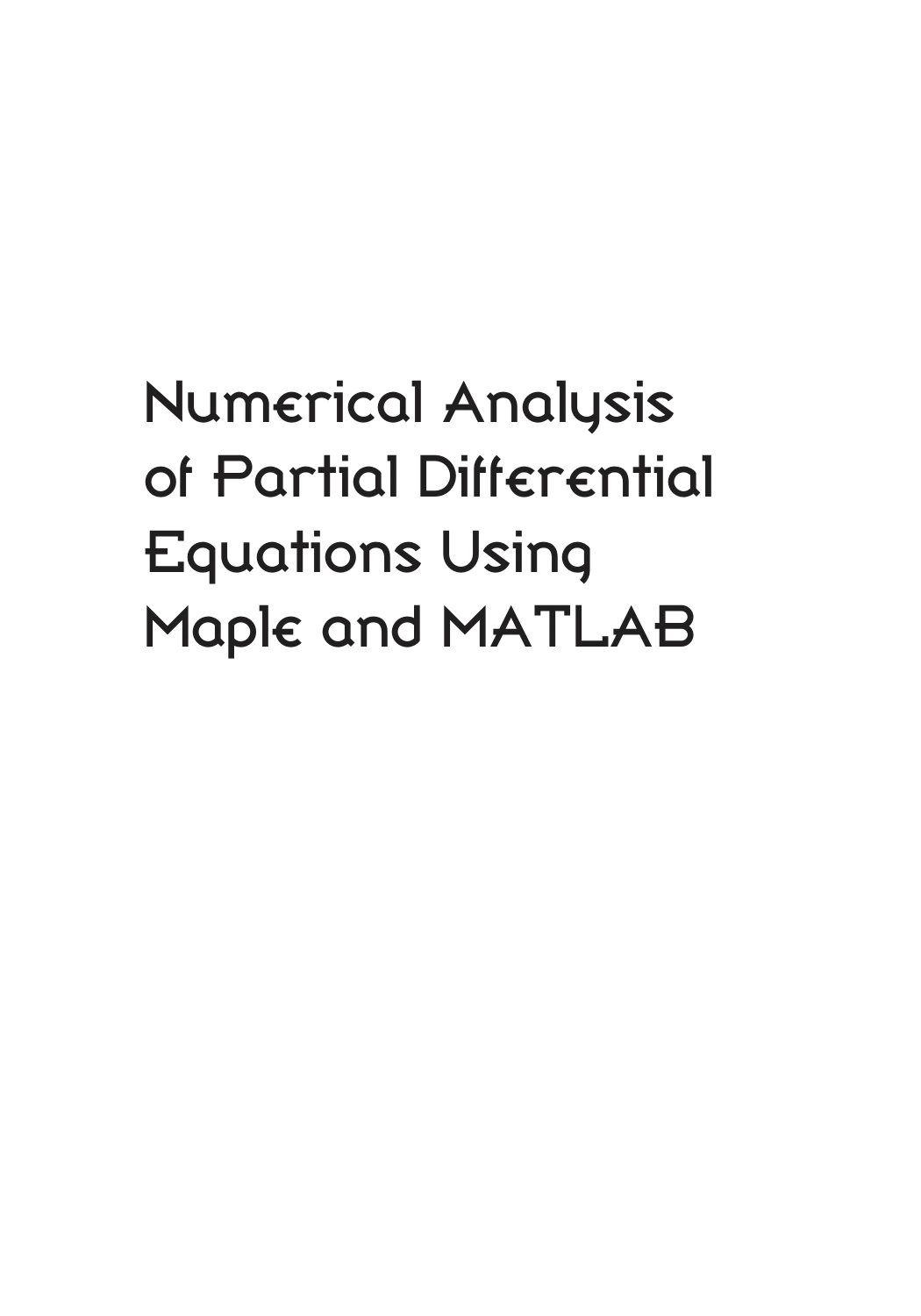
Numerical Analysis of Partial Differential Equations Using Maple and MATLAB
Original price was: $12.00.$6.00Current price is: $6.00.

Martin J. Gander
Product Specs:
- File Type: PDF
- File Size: 6.7 MB
- Book Language: English
- Total Page Count: 159
- Instant Download
Numerical PDEs Without the Usual Fragmentation
Most introductions to partial differential equations focus on a single discretization strategy. Numerical Analysis of Partial Differential Equations Using Maple and MATLAB takes a different route: it brings four foundational numerical methods into one coherent, classroom-tested treatment, showing how each one is built, analyzed, and implemented.
Written by Martin J. Gander and Felix Kwok, the book grew out of graduate courses at McGill University and the University of Geneva. That origin shows in the pacing. The explanations are concise, the arguments are self-contained, and the computational examples are designed to be run rather than merely read.
Four Methods, One Framework
The core chapters introduce the main discretization families used for elliptic PDEs:
- Finite difference methods, including convergence analysis, more accurate approximations, and general boundary conditions.
- Finite volume methods, with attention to boundary conditions, relation to finite differences, and consistency.
- Spectral methods, based on Fourier series, discrete Fourier series, and Chebyshev polynomials.
- Finite element methods, moving from strong and weak forms to discretization, Sobolev spaces, and convergence.
Each method receives enough theoretical depth to understand why it works, but the presentation remains accessible to practitioners. Complete convergence proofs are given in simplified settings, which makes the underlying analysis techniques easier to see and reuse.
Where Maple and MATLAB Enter
The book does not treat software as an afterthought. Maple and MATLAB are used throughout to give readers hands-on experience with the methods. MATLAB codes provide compact first implementations, while Maple supports symbolic work and derivative manipulation. For readers who learn best by experimenting, this combination turns abstract algorithm descriptions into something executable.
An introductory section on PDEs helps readers from different backgrounds get up to speed. Later chapters include problems and projects, making the material suitable for a one-semester course as well as independent study.
A Sense of the Historical Development
The authors also trace how these techniques developed, including quotations from major contributors. That historical thread adds context without turning the book into a survey; the focus remains on understanding and implementing numerical methods.
Who Will Find It Useful
This is a strong fit for upper-level undergraduates and graduate students in mathematics, computational science, and engineering. Researchers and practitioners who need a practical, unified entry point to numerical PDE methods with Maple and MATLAB will also find the book valuable for self-study and reference.
Why It Stands Apart
Many texts cover one method well. This one places finite differences, finite volumes, spectral methods, and finite elements side by side, with a shared analytical approach and runnable code. The result is a compact guide that helps readers compare methods, understand their foundations, and begin using them with confidence.
User Reviews
Be the first to review “Numerical Analysis of Partial Differential Equations Using Maple and MATLAB”
You must be logged in to post a review.
Original price was: $12.00.$6.00Current price is: $6.00.


There are no reviews yet.