

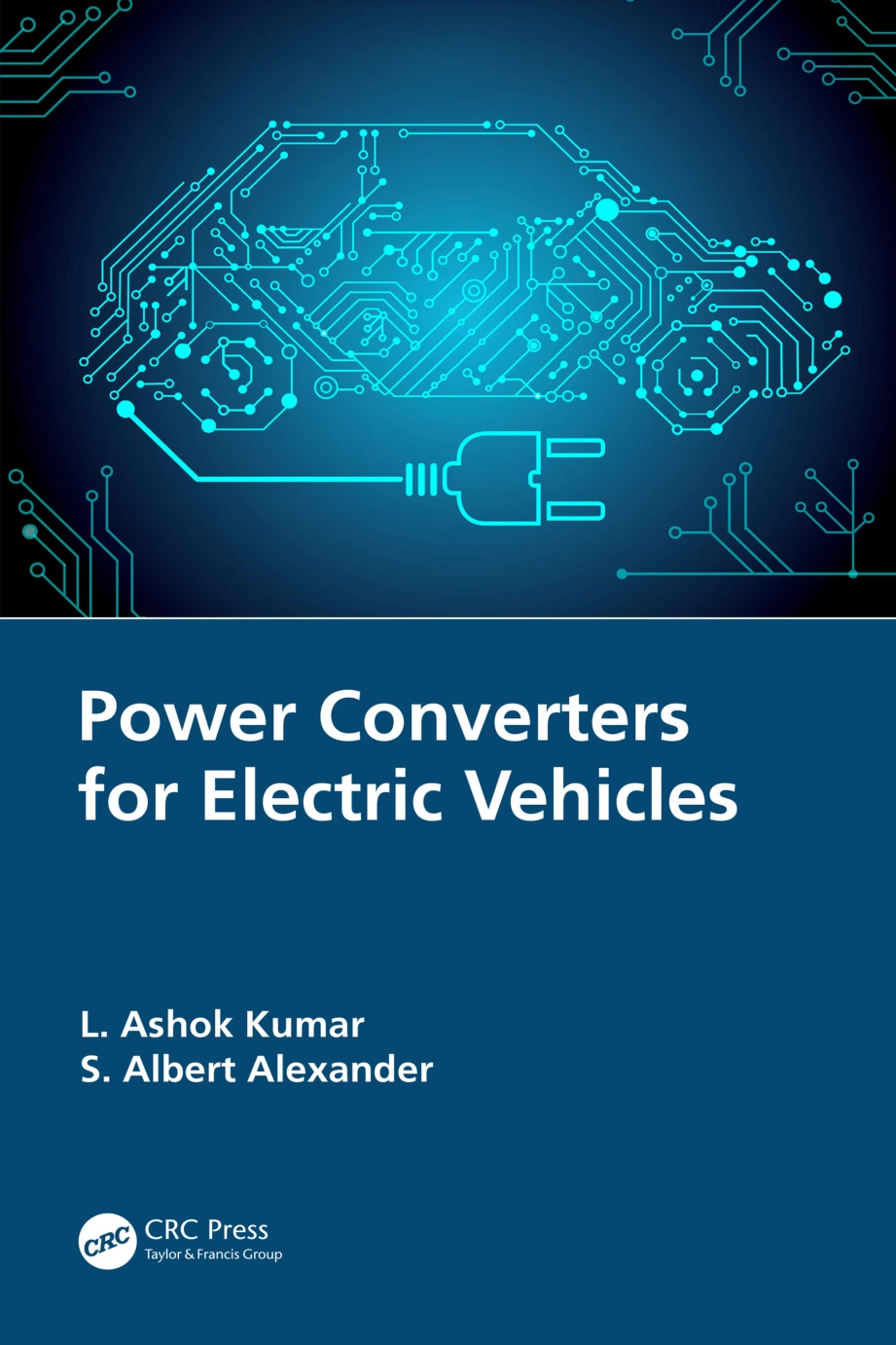
Power Converters for Electric Vehicles
Original price was: $5.00.$2.50Current price is: $2.50.

L. Ashok Kumar
Product Specs:
- File Type: PDF
- File Size: 16.9 MB
- Book Language: English
- Total Page Count: 273
- Instant Download
Power Electronics at the Center of EV Design ⚡
Electric vehicles depend on far more than batteries and motors. Between the grid, the battery pack, the traction motor, and the many auxiliary systems lies a network of power converters that shape voltage, manage current, and control energy flow. Power Converters for Electric Vehicles examines that converter layer in detail, combining converter topologies with simulation studies and practical performance analysis.
The book is written for readers who want engineering-level treatment rather than a general introduction to EVs. It moves from vehicle fundamentals into the circuit architectures that make charging, propulsion, and bidirectional energy exchange possible.
From EV Fundamentals to Charging Infrastructure 🔌
Early chapters establish the wider context: the growth of the electric vehicle market, hybrid and plug-in hybrid configurations, battery and ultra-capacitor storage, motor types, wired and wireless charging, and the impact of EV charging on the power grid. This foundation matters because converter design is never isolated from the vehicle system around it. The choice of motor, charger, storage element, and control strategy all influence the converter requirements.
Bidirectional Converter Topologies
A major portion of the book is devoted to bidirectional converters for plug-in and hybrid vehicles. Topics include bidirectional AC–DC converters with reduced conduction losses, battery chargers, dual active bridge converters for vehicle-to-grid operation, ultra-capacitor applications, integrated onboard chargers, resonant converters, isolated AC–DC converters for DC distribution, T-type converter topologies, multilevel two-quadrant converters for regenerative braking, multiphase integrated onboard chargers, and split converter-fed switched reluctance motor drives.
Each design is presented with attention to operating modes, including plug-in charging, propulsion, boost and buck operation, regenerative braking, and vehicle-to-grid power flow. Simulation and results sections support the discussion by showing how the proposed topologies behave under selected conditions.
Simulation, Control, and Real-Time Performance
The text connects converter theory to implementation through simulation and experimental results. Readers encounter control algorithms, soft-switching concepts such as zero-voltage and zero-current switching, triple-phase-shift control, and performance-improvement paradigms for bidirectional power flow. The emphasis is on understanding how converter behavior changes across modes and how design choices affect efficiency, losses, and response.
Who This Book Is For
- Power electronics engineers working on EV chargers, onboard converters, or DC–DC systems
- Electrical and automotive engineering researchers studying bidirectional power flow and vehicle-to-grid technology
- Graduate students who need a focused technical reference on EV converter topologies
- Practitioners interested in simulation-led design and experimental validation of converter circuits
Why It Matters
As electric and hybrid vehicles become more capable, the converter systems inside them carry more responsibility: faster charging, efficient propulsion, regenerative energy recovery, and grid interaction. This book offers a detailed map of that territory, with enough circuit-level discussion to support advanced study and applied engineering work. Available from Digital Delights as a digital edition.
User Reviews
Be the first to review “Power Converters for Electric Vehicles”
You must be logged in to post a review.
Original price was: $5.00.$2.50Current price is: $2.50.



There are no reviews yet.