

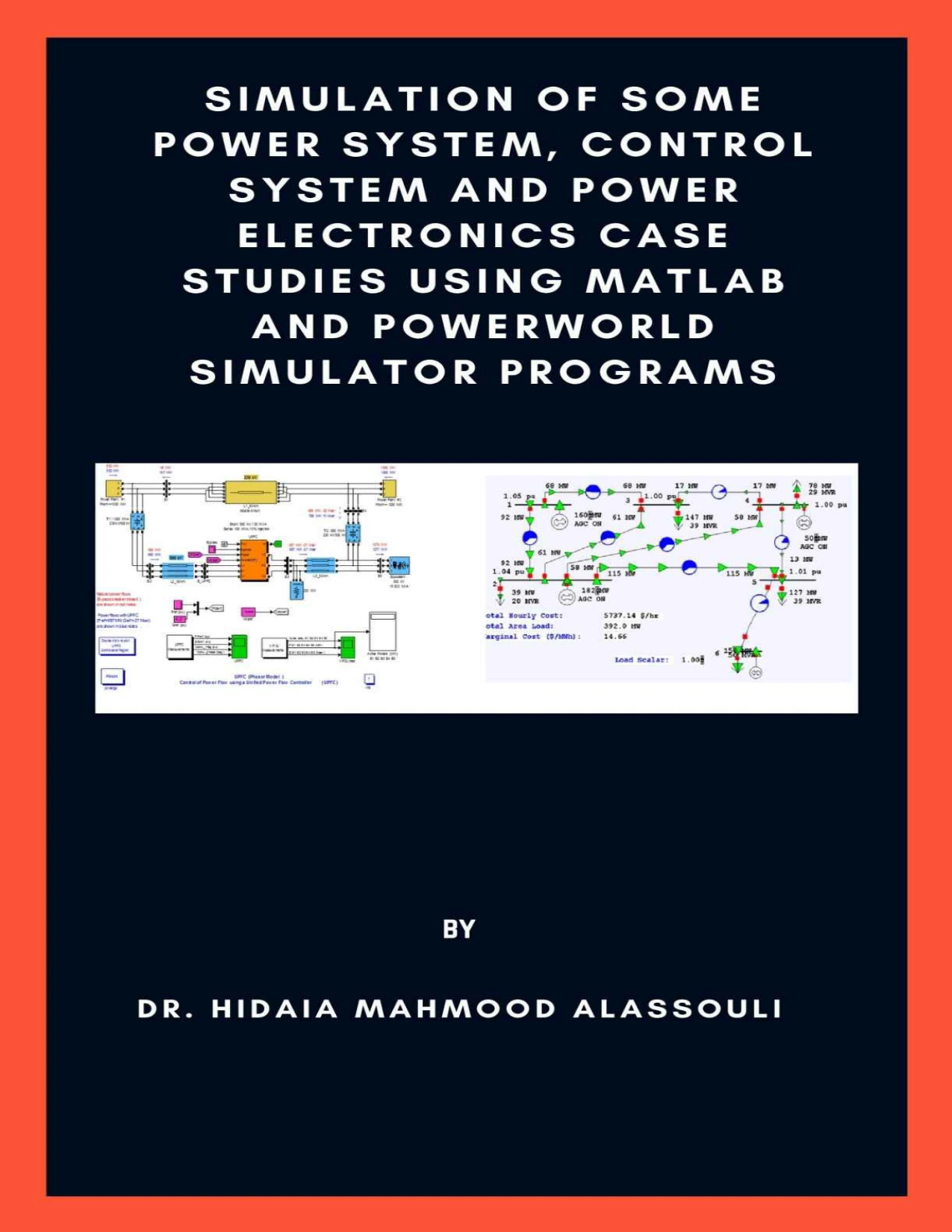
Simulation of Some Power System, Control System and Power Electronics Case Studies Using Matlab and PowerWorld Simulator Programs
Original price was: $5.00.$2.50Current price is: $2.50.

Dr. Hidaia Mahmood Alassouli
Product Specs:
- File Type: PDF
- File Size: 4.5 MB
- Book Language: English
- Total Page Count: 135
- Instant Download
Bridging Theory and Simulation in Power Engineering
Engineers and students working with power systems know that real-world testing is often impractical, expensive, or hazardous. This publication steps in with a focused collection of simulation case studies that demonstrate how to model and analyze power electronics, control systems, and power networks using two widely used tools: MATLAB/Simulink with SimPowerSystems and the PowerWorld Simulator. Rather than dwelling on abstract theory, the author provides concrete examples that translate directly into working models.
Three Core Areas of Simulation Practice
The book is divided into three logical parts, each addressing a distinct area of electrical engineering simulation:
- Part A – Power Electronics Case Studies in SimPowerSystems: Detailed simulations of thyristor-based SVC, transient stability with SVC and PSS, GTO-based STATCOM, load flow control using UPFC, AC and DC motor drives, and VSC-based HVDC links.
- Part B – DC Motor Control Strategies in MATLAB: A systematic comparison of proportional, integral, PI, phase lag, derivative, lead integral, lead lag, PID, and optimal linear quadratic tracker designs.
- Part C – PowerWorld Simulator for Power System Problems: Application of a six-bus network to investigate power flow, economic dispatch, optimal power flow, fault analysis, and load frequency control.
Power Electronics Modeling with SimPowerSystems
Part A offers realistic examples of how to use SimPowerSystems for modeling power system dynamics involving power electronic converters. Each case study walks through the system configuration, control strategy, and key simulation results. For instance, the static var compensator example includes detailed descriptions of measurement, voltage regulation, distribution, and firing units, along with steady-state and dynamic response analysis. This part is particularly useful for those interested in FACTS devices and HVDC technology.
Comparing DC Motor Control Approaches
Part B centers on a simple DC motor driving an inertial load, providing a practical framework for evaluating different control strategies. The text compares classical control methods—P, I, PI, derivative, lead-lag, and PID—against a modern linear quadratic tracker based on optimal control theory. By using the same plant throughout, readers can directly compare performance and understand the trade-offs of each approach.
Power System Analysis with PowerWorld Simulator
Part C focuses on the PowerWorld Simulator program, originally developed by Glover, Overbye, and Sarma. The author uses a six-bus test system, sometimes split into two areas, to examine core power system problems. The simulations cover fundamental topics like power flow, economic dispatch, optimal power flow, fault analysis, and load frequency control. This section helps readers understand how to set up and interpret results from a widely used industry tool.
Who Can Benefit from This Book
The content is best suited for upper-level undergraduate and graduate students in electrical engineering, as well as practicing engineers who need hands-on simulation experience. Researchers and educators will also find the case studies useful for teaching or as templates for further investigation. Familiarity with MATLAB/Simulink and basic power system concepts is assumed, but the step-by-step examples make it accessible to those with moderate programming and simulation background.
Why Simulation Matters in Modern Power Engineering
As power systems incorporate more renewable sources, power electronics, and complex control schemes, simulation has become an indispensable part of design and analysis. This book emphasizes practical, tool-based learning that complements theoretical coursework. By working through the included case studies, readers gain confidence in building models, interpreting results, and applying simulation techniques to real-world challenges.
User Reviews
Be the first to review “Simulation of Some Power System, Control System and Power Electronics Case Studies Using Matlab and PowerWorld Simulator Programs”
You must be logged in to post a review.
Evaluation of Some Websites that Offer Virtual Phone Numbers for SMS Reception and Websites to Obtain Virtual Debit/Credit Cards for Online Accounts Verifications
Sold by Dr. Hidaia Mahmood Alassouli Original price was: $5.00.$2.50Current price is: $2.50.


There are no reviews yet.