

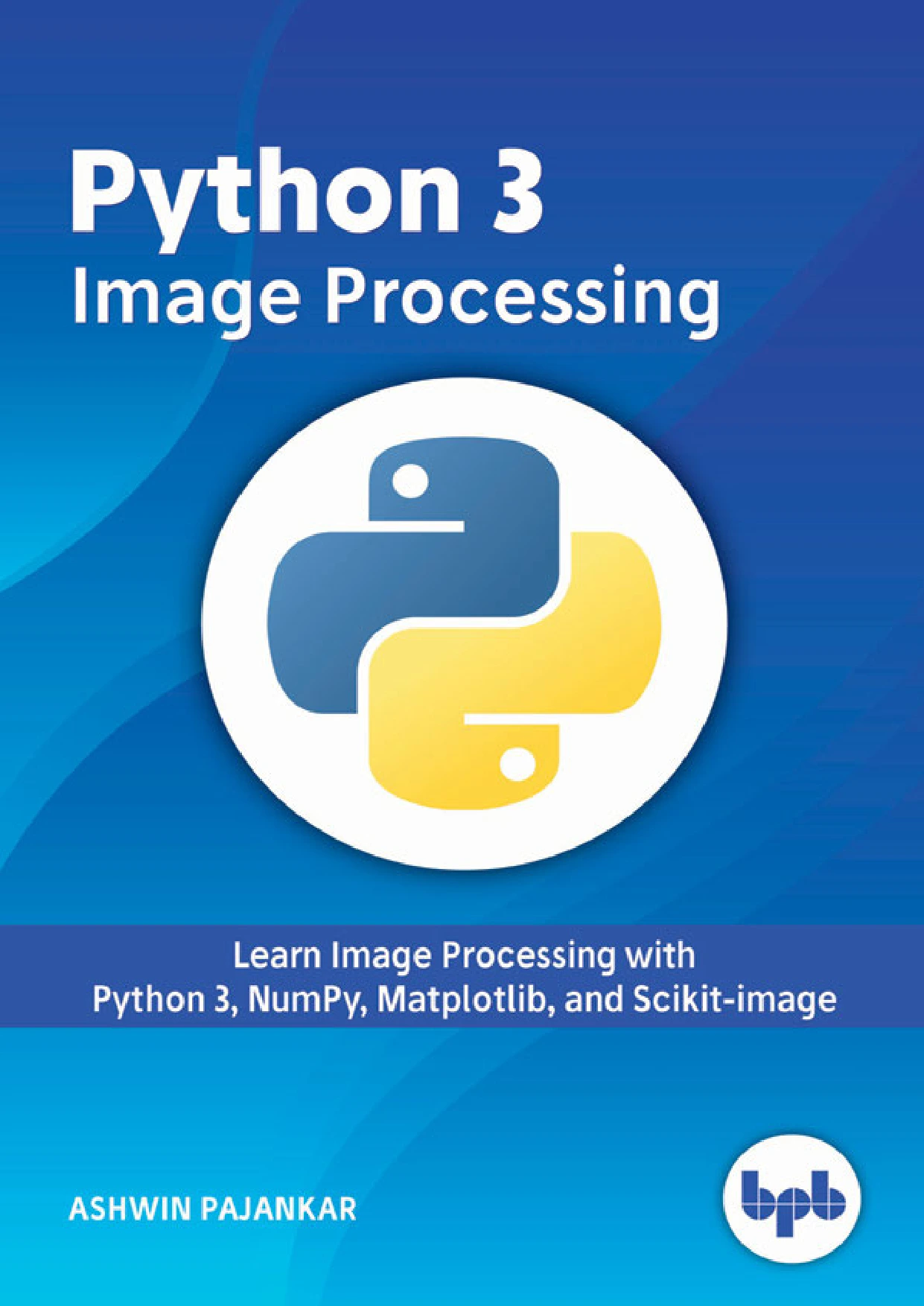
Python 3 Image Processing: Learn Image Processing with Python 3, NumPy, Matplotlib, and Scikit-image
Original price was: $5.00.$2.50Current price is: $2.50.

Ashwin Pajankar
Product Specs:
- File Type: PDF
- File Size: 7.4 MB
- Book Language: English
- Total Page Count: 139
- Instant Download
Hands-On Image Processing with Python 🐍
Python 3 Image Processing is a practical introduction to the scientific Python ecosystem as it applies to images. Written by Ashwin Pajankar, the book guides readers from foundational ideas about signals and digital images into working code with Python 3, NumPy, Matplotlib, Pillow, and scikit-image. The approach is deliberately step-by-step: concepts are introduced, then demonstrated through code and exercises designed to make image processing feel concrete rather than abstract.
The book covers both setup and technique. Early chapters explain how to install Python 3 on Windows and how to work with Raspberry Pi and Raspbian, giving readers a path into the environment even if they are new to scientific computing. From there, the material moves into NumPy arrays, Matplotlib visualization, image reading and writing, histograms, masks, channels, and arithmetic operations.
From NumPy Arrays to Real Image Operations 💡
Once the core tools are in place, the book explores image processing tasks that form the backbone of computer vision work. Readers encounter greyscale conversion, thresholding, tinting, shading, gradients, intensity normalization, color-space conversion, histogram equalization, image transformations, convolution, kernels, filters, morphological operations, inpainting, noise removal, and edge detection.
Later chapters introduce scikit-image in detail. Topics such as Otsu’s binarization, adaptive thresholding, built-in filters, Canny edge detection, SLIC segmentation, and contour handling show how the library can simplify common tasks while still allowing a clear view of what happens under the hood.
A Scientific Python Stack for Image Work 📊
The book ties together several tools that are widely used in data science, computer vision, and research:
- Python 3 as the programming language and environment
- NumPy for numerical arrays and pixel-level operations
- Matplotlib for visualizing images, plots, and histograms
- Pillow for reading and saving image files
- scikit-image for higher-level image processing algorithms
- Jupyter Notebook as an interactive workspace
This combination makes the book useful not only as a first look at image processing, but also as a bridge into computer vision, scientific computing, and data-driven projects.
Who Will Find It Useful? 🖼️
The preface describes the book as suitable for complete novices and still valuable for advanced readers. In practice, it is likely to suit students in computer science, electronics, and electrical engineering who need practical project work, as well as software and IT professionals who are beginning scientific computing or moving toward computer vision. Raspberry Pi users may appreciate the dedicated setup chapters and the option to run examples on small-board hardware.
Because the author emphasizes incremental explanations and practical programs, readers who prefer learning by doing will find the structure especially helpful. The material does not assume prior expertise in image processing, though some familiarity with basic programming will make the journey smoother.
A Practical Starting Point for Computer Vision
Python 3 Image Processing does not treat image processing as a collection of isolated formulas. It builds a workflow: set up the environment, understand the array representation of images, visualize results, then apply algorithms that reveal edges, shapes, textures, and regions. That workflow is the same one used in many computer vision pipelines, making the book a grounded starting point for further study.
For readers who want to move from theory to working code with a clear, guided path, this first edition offers a focused and approachable resource in digital form from Digital Delights.
User Reviews
Be the first to review “Python 3 Image Processing: Learn Image Processing with Python 3, NumPy, Matplotlib, and Scikit-image”
You must be logged in to post a review.
Practical Python Data Visualization: A Fast Track Approach To Learning Data Visualization With Python
Sold by Ashwin Pajankar
Practical Linux with Raspberry Pi OS: Quick Start
Sold by Ashwin Pajankar
Raspberry Pi Computer Vision Programming, Second Edition
Sold by Ashwin Pajankar
Kickstart to Python 3: An Ultra-Rapid Programming Course
Sold by Ashwin Pajankar Original price was: $5.00.$2.50Current price is: $2.50.






There are no reviews yet.