

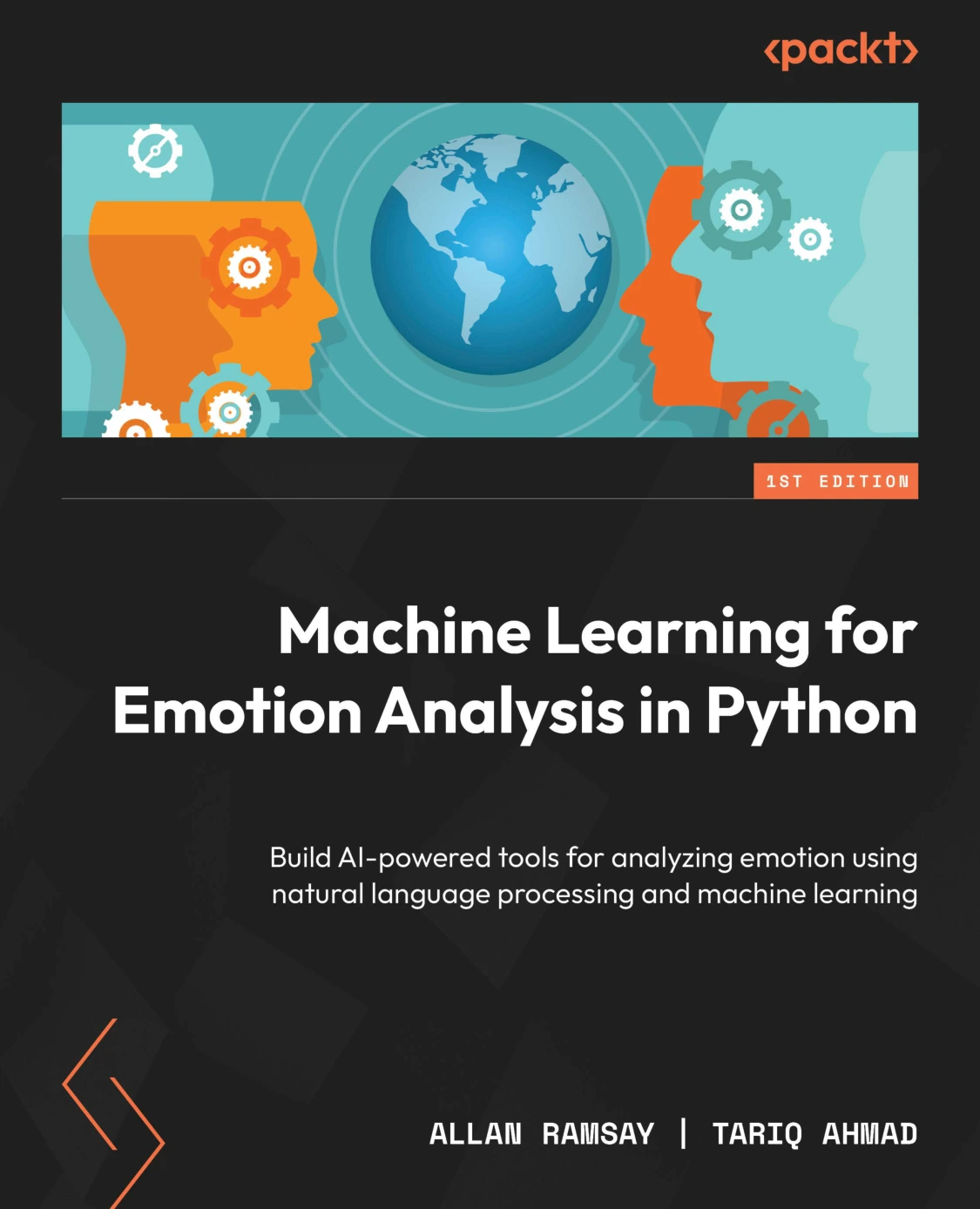
Machine Learning for Emotion Analysis in Python
Original price was: $35.99.$18.00Current price is: $18.00.

Allan Ramsay
Product Specs:
- File Type: PDF
- File Size: 26.2 MB
- Book Language: English
- Total Page Count: 334
- Instant Download
Text carries more than a positive or negative opinion: it can express anger, joy, uncertainty, sadness, and other emotions, often in informal or ambiguous language. Machine Learning for Emotion Analysis in Python by Allan Ramsay and Tariq Ahmad shows how to approach that challenge with natural language processing and machine-learning methods, tracing the work from preparing data to testing classifiers.
The book is as attentive to the quality of the evidence as to the choice of algorithm. Its practical focus on datasets, annotation, preprocessing, and evaluation helps readers see how decisions made before model training shape what a system can reasonably identify.
Start with language, emotion, and the data
The opening chapters establish key distinctions between emotion and sentiment, introduce NLP and machine learning, and consider why emotion analysis is useful—and difficult. From there, Ramsay and Ahmad turn to finding or building datasets, transforming data for a particular task, evaluating results, and producing dependable labels through a thoughtful annotation process.
Follow the workflow from text to model
Preprocessing topics include tokenization, morphology, stemming, tagging, and parsing. The book then compares several approaches to text classification, including sentiment lexicons, vector-space models, naïve Bayes, support vector machines, neural networks, and transformers. Python examples and experiments connect the concepts to implementation.
- Explore dataset sources, collection, transformation, and evaluation.
- Examine data labeling, annotation quality, and inter-annotator reliability.
- Compare established machine-learning methods for emotion and sentiment tasks.
- Consider multiclass classification and analysis of less-curated real-world data.
Beyond a tidy benchmark
Later material considers what happens when classifiers encounter data unlike the carefully prepared examples used during training. A case study on the Qatar blockade brings that concern into view, examining emotion patterns in real-world material over time. The result is a book that addresses both model-building and the interpretive care needed when applying those models to language.
For readers working with Python and text
This book will interest Python developers, data scientists, NLP practitioners, and researchers who want to understand the mechanics of emotion analysis, from annotation choices to model evaluation. Readers gain a structured tour of the tools and workflow rather than a treatment of any one classifier in isolation.
User Reviews
Be the first to review “Machine Learning for Emotion Analysis in Python”
You must be logged in to post a review.
Original price was: $35.99.$18.00Current price is: $18.00.




There are no reviews yet.