

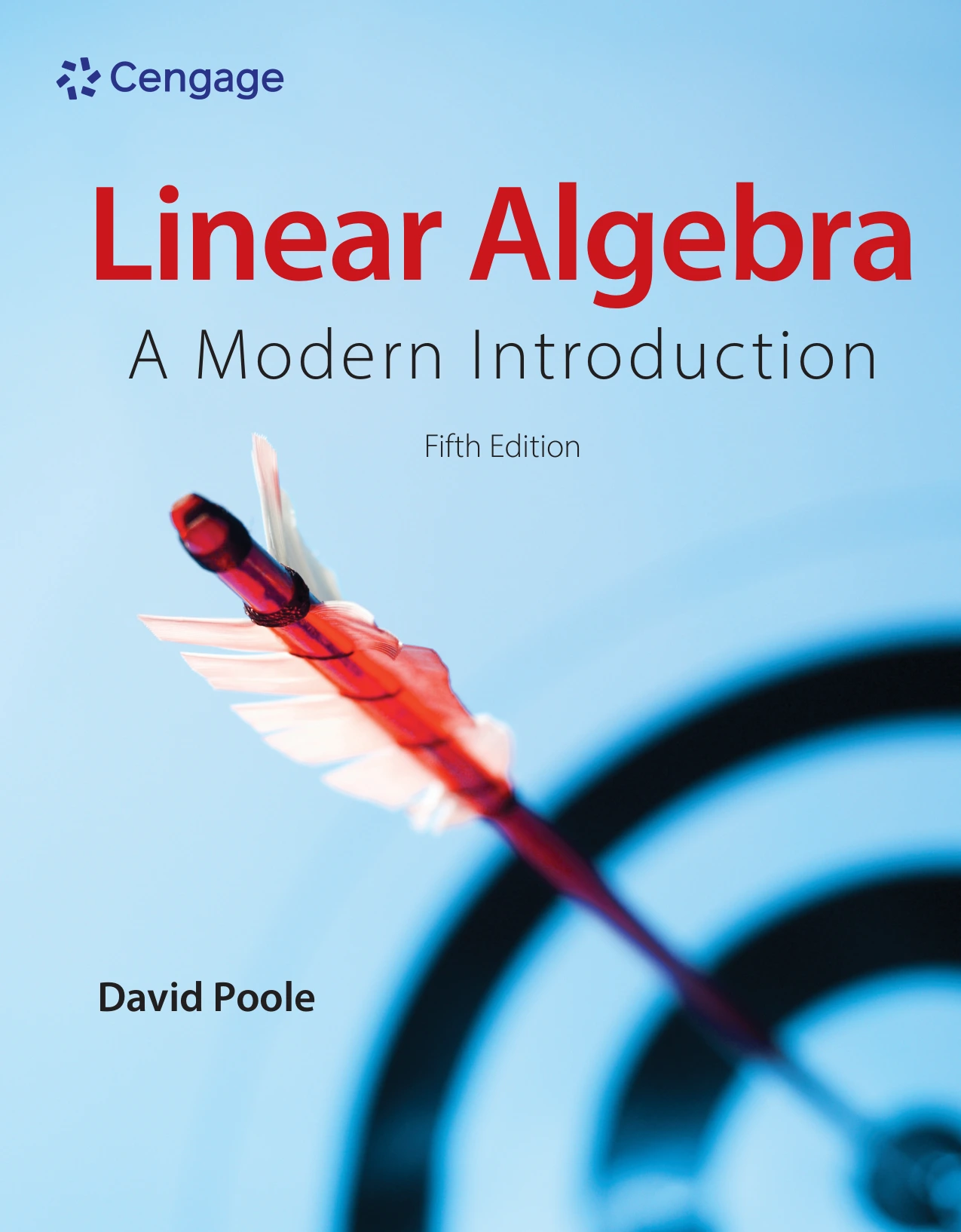
Linear Algebra: A Modern Introduction
Original price was: $71.99.$35.99Current price is: $35.99.

David Poole
Product Specs:
- File Type: PDF
- File Size: 21.0 MB
- Book Language: English
- Total Page Count: 660
- Instant Download
Linear algebra becomes easier to approach when geometric intuition and computation are allowed to work together. In Linear Algebra: A Modern Introduction, David Poole begins with vectors and their geometry, then builds toward the structures and methods that make linear algebra useful across mathematics and applied fields.
This fifth edition moves from vectors and systems of equations to matrices, eigenvalues, orthogonality, vector spaces, and approximation. Along the way, applications show how these ideas can model problems involving networks, robotics, population growth, image compression, and more.
Start with vectors; build toward abstraction
The opening chapters develop vector geometry, dot products, lines and planes, and methods for solving linear systems. From there, the book introduces matrix operations, inverses, LU factorization, subspaces, bases, dimension, rank, and linear transformations. The progression gives readers a concrete foundation before asking them to work with more abstract concepts.
See the mathematics at work
Applications and examples connect the subject to settings beyond a conventional list of calculations. The contents include resource allocation, balancing chemical equations, network analysis, electrical networks, linear economic models, robotics, Markov chains, and population growth. Later topics include ranking sports teams and searching the Internet, digital image compression, and principal component analysis.
Explore the ideas from different angles
Explorations, vignettes, and writing projects sit alongside the main chapter sequence. Topics include the history of elimination and vector spaces, geometric applications of determinants, the QR algorithm, tilings and lattices, and taxicab geometry. These features invite readers to connect techniques with their mathematical background and broader applications.
For students developing mathematical maturity
The book is suited to students taking an introductory linear algebra course who want to understand both how procedures work and why the underlying concepts matter. Its coverage spans computational techniques and theoretical ideas, with chapter reviews and appendices on proof, induction, complex numbers, and polynomials supporting the main text.
For a course that treats linear algebra as both a coherent mathematical subject and a practical modeling tool, Poole’s fifth edition offers a broad, carefully staged introduction.
User Reviews
Be the first to review “Linear Algebra: A Modern Introduction”
You must be logged in to post a review.
Original price was: $71.99.$35.99Current price is: $35.99.






There are no reviews yet.