
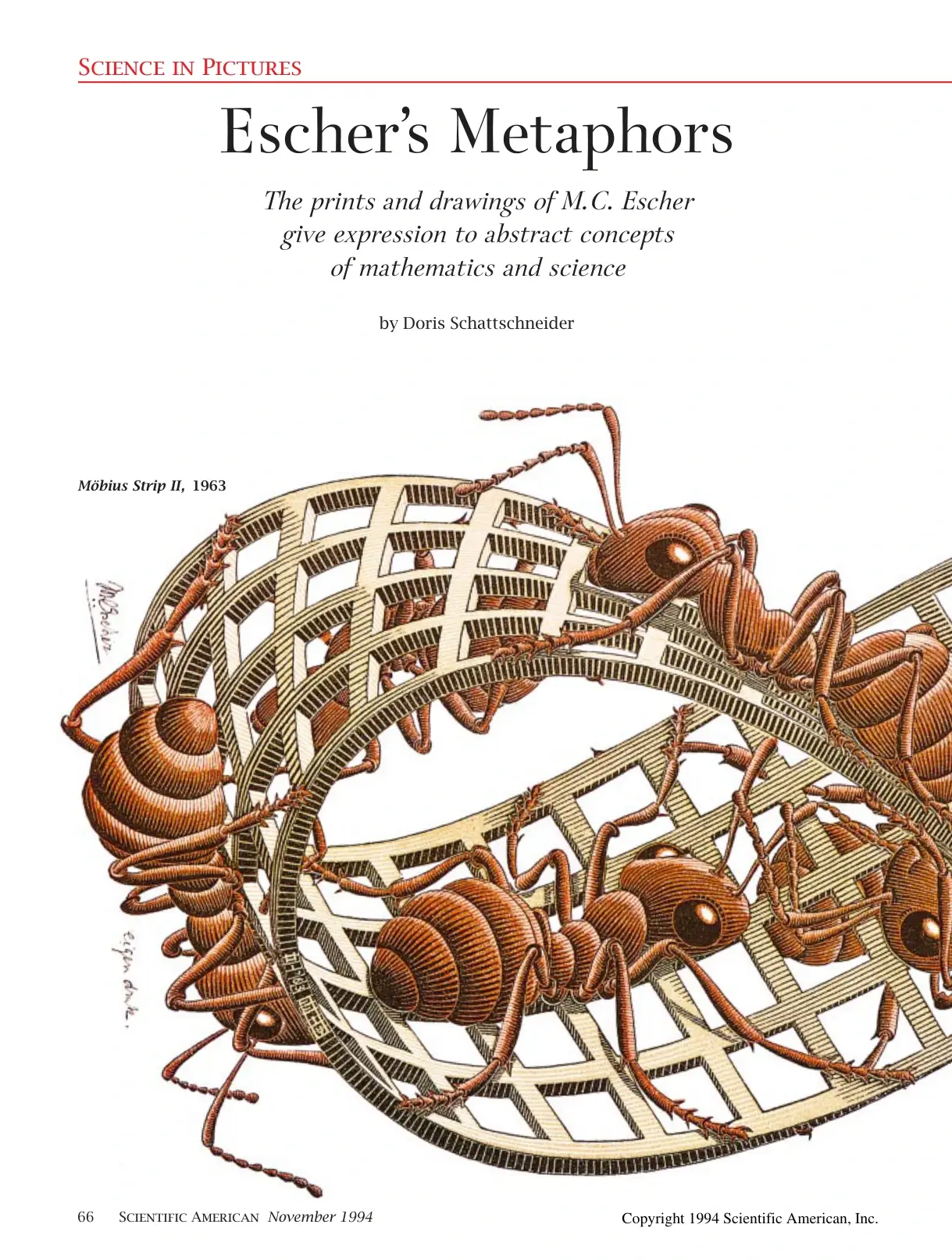
Description
Escher’s Metaphors
Escher’s Metaphors is a digital PDF by Doris Schattschneider about the mathematical and scientific ideas expressed in M. C. Escher’s prints and drawings. It is available as an instant download.
Published in Scientific American in November 1994, this six-page illustrated article connects Escher’s visual work with concepts including symmetry, duality, self-similarity, dimension, relativity, reflection, and infinity.
The article is intended for readers interested in M. C. Escher, geometry, mathematics and art, and the relationship between scientific ideas and visual expression.
Escher’s Metaphors: Book Overview
Doris Schattschneider presents Escher’s art as a series of visual metaphors for abstract concepts. The discussion considers his fascination with order, symmetry, tiling, geometric patterns, and the challenge of representing infinity within the boundaries of a single print.
The article also follows Escher’s engagement with mathematical ideas and mathematicians. It describes how works such as Circle Limit IV and Square Limit represent repetition, hyperbolic tiling, recursive construction, and self-similar patterns, while other prints explore changing viewpoints and the ambiguity between two and three dimensions.
Category: Art. Author: Doris Schattschneider.
What You’ll Discover Inside
- How Möbius Strip II presents an endless cycle and a one-sided loop.
- How Triangle System I B3 Type 2 demonstrates rotational and translational symmetry.
- How Circle Limit IV explores duality and hyperbolic tiling.
- How Square Limit uses recursive construction to create self-similar patterns.
- How Day and Night and High and Low challenge ordinary perceptions of dimension, context, and vantage point.
- How Puddle uses reflection and Whirlpools confines infinity within a finite print.
Why This Book Matters
Escher’s Metaphors offers a concise account of the meeting point between graphic art, geometry, and scientific thought. It shows how visual works can make ideas such as symmetry, infinity, duality, and dimensional ambiguity accessible through careful observation.
The article also records Escher’s intellectual contact with mathematicians, including H. S. M. Coxeter, while remaining focused on the prints and the concepts they express.
Book Details
| Title | Escher’s Metaphors |
|---|---|
| Author | Doris Schattschneider |
| Publication | Scientific American |
| Publication Date | November 1994 |
| Pages | 6 |
| Page Count | 6 |
| Format | Digital download |
| File Type | |
| File Size | 1.3 MB |
| File Size Bytes | 1338333 |
| Language | English |
Device Compatibility
This is a digital download with no physical shipping. Access is available after purchase.
The PDF works with appropriate Kindle apps, tablets, desktop computers, mobile devices, and compatible reading apps.
FAQ
When can I access the file?
Access is available after purchase as an instant digital download.
Will I receive a physical copy?
No. This product is a digital PDF, and no physical item is shipped.
Which devices can open it?
You can read the PDF with compatible Kindle apps, tablets, desktop or mobile devices, and reading apps.
Download Escher’s Metaphors for a focused digital reading experience on the mathematical and scientific ideas found in M. C. Escher’s art.



Reviews
There are no reviews yet.