

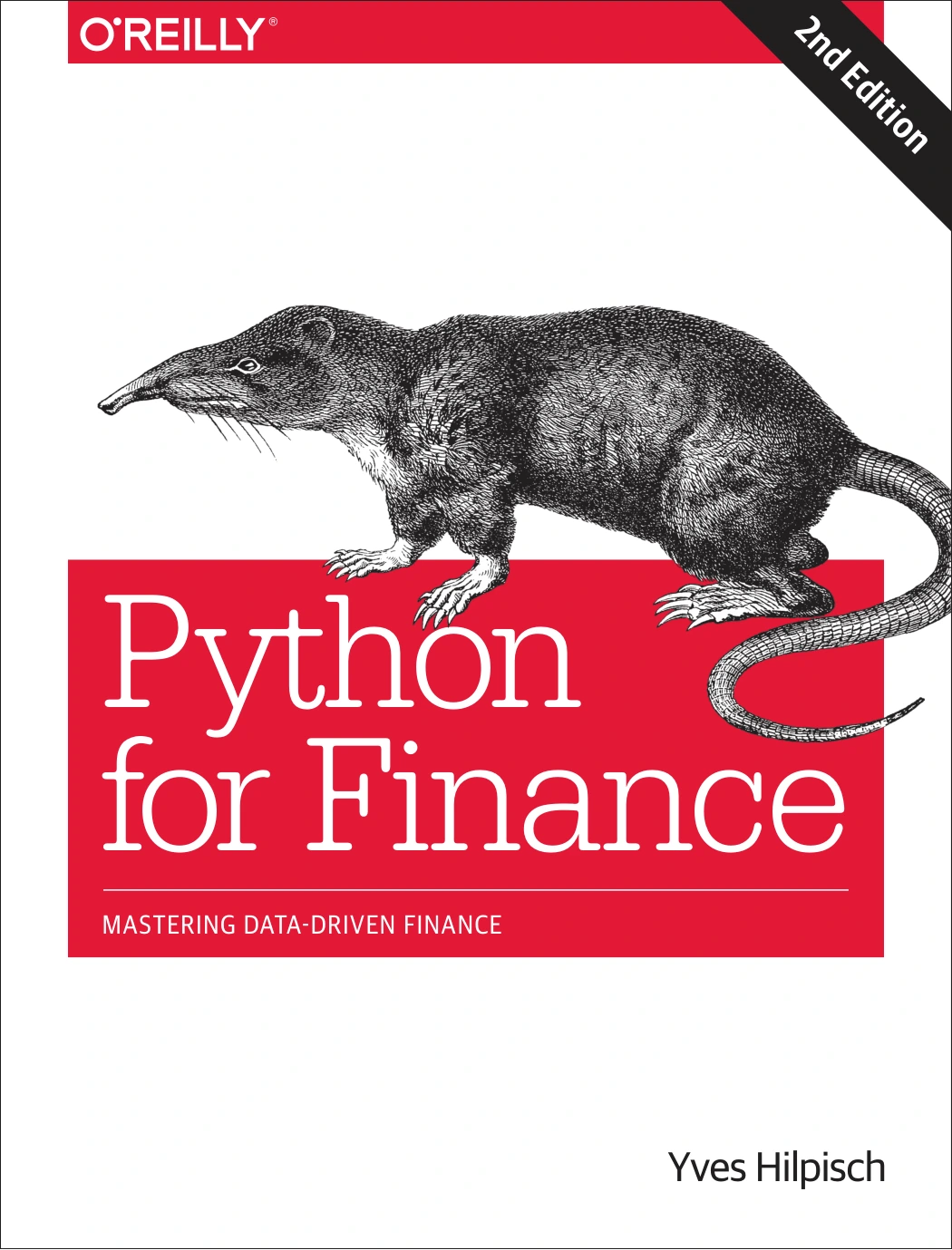
Python for Finance: Mastering Data-Driven Finance, Second Edition
Original price was: $5.00.$2.50Current price is: $2.50.

Yves Hilpisch
Product Specs:
- File Type: PDF
- File Size: 32.0 MB
- Book Language: English
- Total Page Count: 714
- Instant Download
Where Python Meets Quantitative Finance 💻
Python for Finance: Mastering Data-Driven Finance is the second edition of Yves Hilpisch’s guide to using Python as a serious tool for financial analysis, modeling, and production workflows. Published by O’Reilly Media, it connects the language’s scientific ecosystem with the daily realities of financial data: importing and cleaning market information, analyzing time series, running numerical experiments, valuing derivatives, and measuring risk. The result is a book that treats Python not as a side skill but as part of the working infrastructure of modern finance.
From the Scientific Stack to Financial Data Science 📊
The opening sections establish the Python landscape and the tools that make finance work: the scientific stack, conda environments, Docker containers, and cloud instances. From there, the book builds through core data types, NumPy arrays, pandas DataFrames, object-oriented programming, and visualization. It then moves into financial data handling, including import, summary statistics, resampling, rolling statistics, correlation analysis, and high-frequency data.
Performance, Numerical Methods, and Simulation
Later chapters address the practical side of making Python fast and reliable. Readers encounter loops in Python, NumPy, Numba, and Cython; algorithms such as binomial trees and Monte Carlo simulation; interpolation, regression, convex optimization, and symbolic computation. The material shows how these methods fit together when the goal is not just a one-off calculation but a repeatable analytical process.
Derivatives, Risk, and Applied Valuation 🧠
- Random numbers, simulation, and stochastic processes
- Variance reduction techniques
- European and American option valuation
- Value-at-Risk and credit valuation adjustments
These chapters bring the book’s earlier Python and data-science foundations into direct contact with quantitative finance problems. The emphasis is on building understanding through code, examples, and numerical methods that can be adapted to real analytical tasks.
Who May Find This Second Edition Useful
This edition is relevant to analysts, quants, data scientists, students, and developers who want to apply Python within finance. It can support a structured read from start to finish, but it also works as a reference when a specific technique—pandas aggregation, Monte Carlo simulation, optimization, or risk measurement—needs a practical starting point. Some prior familiarity with programming and financial concepts will help, though the book lays out the Python foundations before advancing into specialized applications.
A Practical Reference for Data-Driven Finance
What makes this edition distinctive is its range: it moves from environment setup and core Python to financial data science, numerical performance, derivatives pricing, and risk. The second edition reflects a finance world increasingly shaped by data, automation, and AI-first thinking, while keeping the focus on usable code and reproducible workflows. For readers who want their Python skills to meet the demands of quantitative finance, it remains a substantial and directly applicable resource.
User Reviews
Only logged in customers who have purchased this product may leave a review.
Original price was: $5.00.$2.50Current price is: $2.50.

There are no reviews yet.