

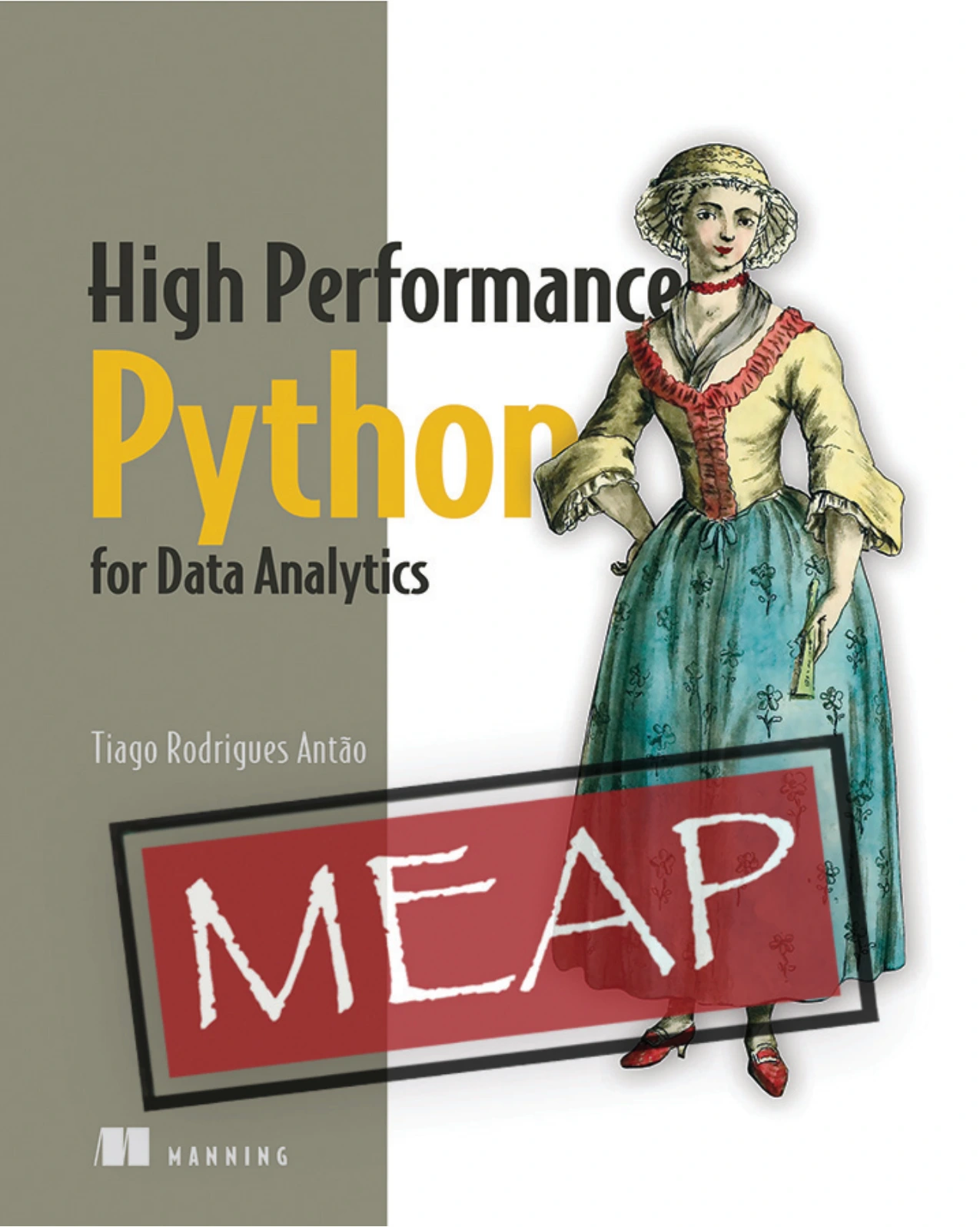
High Performance Python for Data Analytics
Original price was: $5.00.$2.50Current price is: $2.50.

Tiago Rodrigues Antão
Product Specs:
- File Type: PDF
- File Size: 10.4 MB
- Book Language: English
- Total Page Count: 98
- Instant Download
When a Python data workflow starts straining under larger datasets, adding more machines is not always the simplest answer. This advanced manuscript takes a broader view of performance: how code uses processors, memory, storage, and networks—and how the right optimization depends on where the work will run.
Written for programmers who already have practical Python experience, it focuses on making data-analysis workloads more efficient, rather than teaching Python basics or data analytics concepts. The aim is practical: understand where resources are going, then choose an approach that fits the problem and its computing environment.
From Python code to the computing environment
The book opens with the pressures behind efficient computing and storage, then builds a toolkit across computation, persistence, and advanced techniques. Its perspective is deliberately contextual: a solution that works well on one computer may not be the right choice for a cluster or cloud setting.
Make computation work harder
Topics include efficient use of Python’s built-in features, concurrency, parallelism and asynchronous processing, and more effective use of NumPy. Later chapters explore rewriting critical code with Cython and working with Pandas and Apache Arrow. Together, these subjects give experienced developers several ways to think about performance beyond simply replacing an entire application.
Give data storage the same attention
Computation is only part of the picture. The manuscript also considers CPU and storage hierarchies, file-system characteristics, and ways to persist large amounts of data efficiently. That focus is useful when a workload is limited not only by processing, but also by how data is read, written, and represented.
Explore advanced options
GPU computing and sub-sampling round out the advanced topics. Across the book, the guiding idea is to match a technique to the workload and platform—not to assume that more infrastructure is automatically the best answer.
For Python programmers ready to optimize
This publication is aimed at readers who already know Python and work with tools such as NumPy or Pandas, and who want to reason more carefully about efficient data processing. It offers a structured path through code-level, library, storage, and hardware considerations for that next stage of practice.
User Reviews
Be the first to review “High Performance Python for Data Analytics”
You must be logged in to post a review.
Original price was: $5.00.$2.50Current price is: $2.50.


There are no reviews yet.