

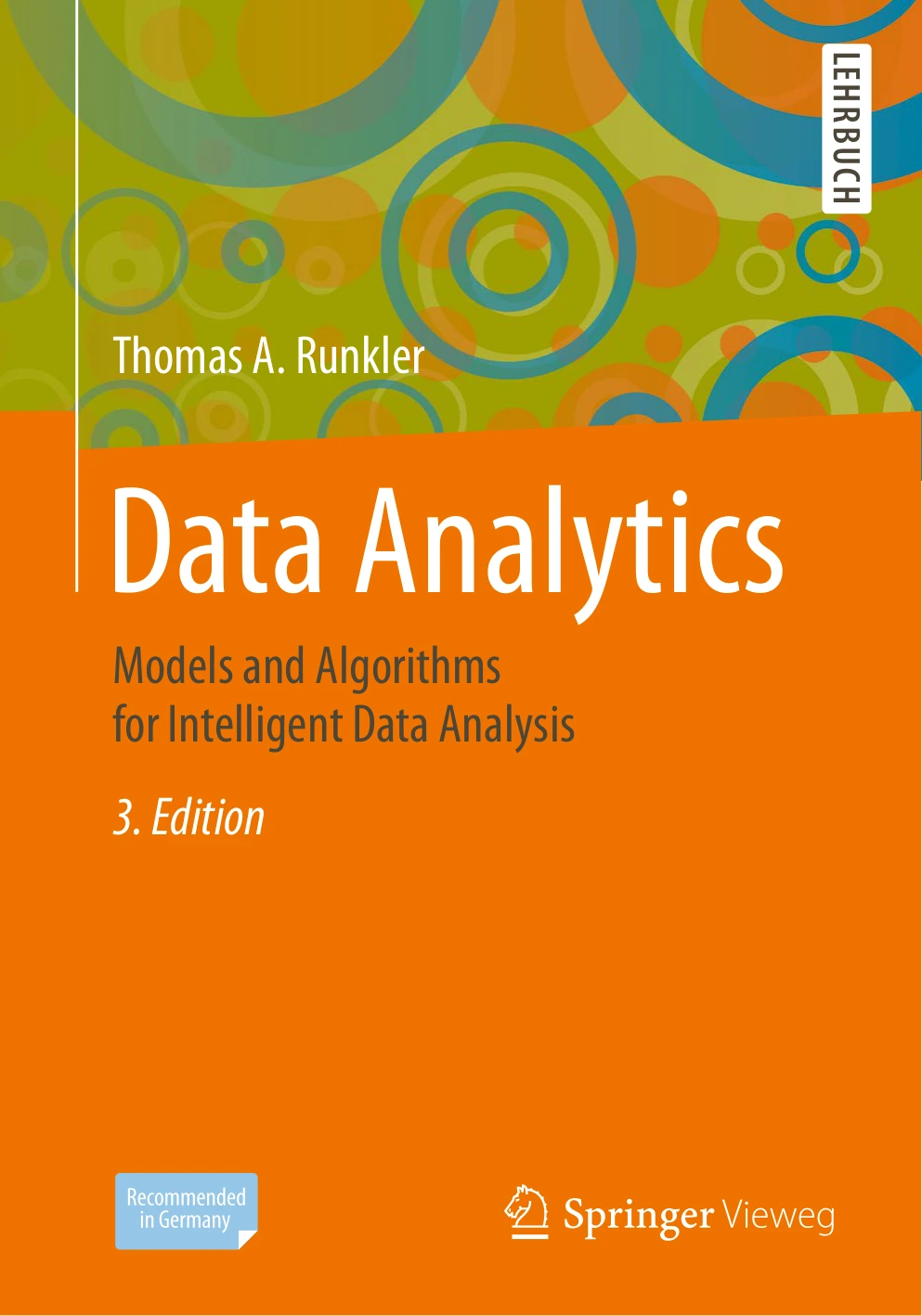
Data Analytics: Models and Algorithms for Intelligent Data Analysis
Original price was: $44.99.$22.50Current price is: $22.50.

Thomas A. Runkler
Product Specs:
- File Type: PDF
- File Size: 5.9 MB
- Book Language: English
- Total Page Count: 167
- Instant Download
Good data analysis depends on more than choosing an algorithm. It also requires understanding the data, preparing it carefully, and matching a method to the question at hand. Data Analytics follows that practical arc, bringing together models and algorithms for intelligent data analysis in a textbook designed for coursework and real-world projects.
Thomas A. Runkler moves from data representation and preprocessing to visualization, statistical relationships, predictive models, classification, and clustering. Along the way, the book introduces methods from several connected fields—including statistics, machine learning, pattern recognition, and artificial intelligence—so readers can see how different analytical approaches fit into a broader workflow.
Follow the work from raw data to analysis
The early chapters address data and relationships, preprocessing, and visualization. This foundation leads into correlation and the distinction between correlation and causality, then to regression and forecasting. The sequence keeps attention on the practical choices involved in preparing data and interpreting what an analysis can—and cannot—show.
Explore a broad toolkit of analytical methods
Later chapters introduce approaches for classification and clustering, including Naive Bayes, linear discriminant analysis, support vector machines, nearest-neighbor classification, decision trees, fuzzy clustering, and self-organizing maps. The book also covers neural networks, feature selection, cross-validation, and dimensionality-reduction techniques such as principal component analysis. A closing review introduces selected optimization methods.
Connect concepts to project decisions
Rather than treating data analytics as a collection of disconnected techniques, the book presents its material around the stages of typical projects. That organization can help readers compare methods, understand where they belong in an analysis, and make more informed choices for a particular task.
For students and working practitioners
The author identifies undergraduate and graduate students in engineering, computer science, and mathematics, along with practitioners undertaking analytics projects, as readers for this text. Its stated mathematical prerequisite is basic mathematics. It may suit readers seeking a structured introduction to core analytical methods and the reasoning behind selecting among them.
This third edition offers a wide-ranging foundation in data analytics, from representing and preparing data to building and assessing models.
User Reviews
Be the first to review “Data Analytics: Models and Algorithms for Intelligent Data Analysis”
You must be logged in to post a review.
Original price was: $44.99.$22.50Current price is: $22.50.
There are no reviews yet.