

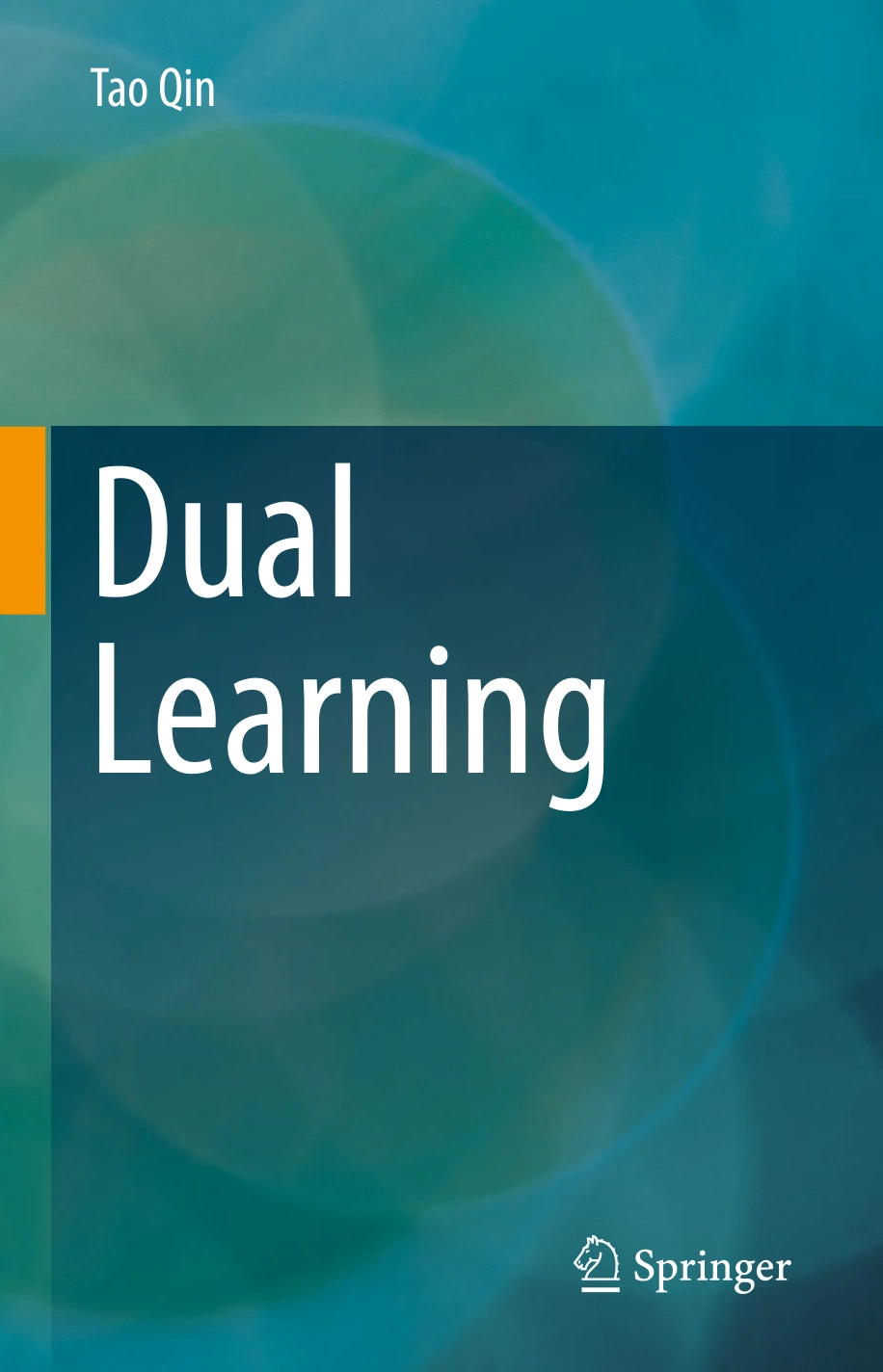
Dual Learning
Original price was: $72.64.$36.32Current price is: $36.32.

Tao Qin
Product Specs:
- File Type: PDF
- File Size: 3.8 MB
- Book Language: English
- Total Page Count: 191
- Instant Download
Many AI problems have a natural counterpart: translating in one direction and then back again, recognizing speech and synthesizing it, or answering a question and generating one. In Dual Learning, Tao Qin examines how these relationships can become useful learning signals—an idea with applications across language, vision, and speech.
This research-oriented overview builds from the fundamentals toward the framework’s principles, algorithms, applications, and theoretical connections. Its opening chapters introduce machine learning and deep learning before the discussion turns to dual learning itself.
How paired tasks shape learning
The book develops dual learning through two central perspectives. The dual reconstruction principle uses linked tasks and reconstruction to provide feedback; the probabilistic principle explores relationships between the probability models of paired tasks. Qin also covers dual semi-supervised and unsupervised learning, dual supervised learning, and dual inference.
From translation to speech and vision
Applications give the framework concrete form. Chapters explore machine translation, image-to-image translation, and speech processing, alongside work involving question answering and generation, image classification and generation, sentiment analysis, and code summarization and generation. The examples show how a common idea can be examined across very different AI tasks.
Foundations, applications, and theory
Rather than treating dual learning as a single algorithm, Dual Learning lays out its principles and varied learning settings, then considers theoretical studies and connections to other learning paradigms. The result is a structured way to understand both the motivating ideas and the breadth of research built around them.
Who may find it useful
Researchers and undergraduate or graduate students in machine learning, computer vision, natural language, and speech will find the material especially relevant. Practitioners interested in the research landscape may also appreciate its cross-disciplinary view. Some subject background is helpful, while the early chapters offer brief introductions to machine learning and deep learning.
User Reviews
Only logged in customers who have purchased this product may leave a review.
Original price was: $72.64.$36.32Current price is: $36.32.





There are no reviews yet.