

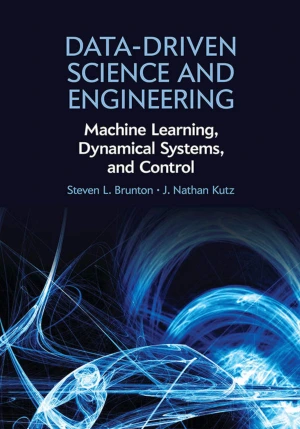
Data-Driven Science and Engineering: Machine Learning, Dynamical Systems, and Control
Original price was: $67.99.$33.99Current price is: $33.99.

Steven L. Brunton
Product Specs:
- File Type: PDF
- File Size: 72.7 MB
- Book Language: English
- Total Page Count: 495
- Instant Download
How can data reveal the structure of a complex system—and help us model, predict, or control it? Data-Driven Science and Engineering brings machine learning into conversation with engineering mathematics, mathematical physics, and dynamical systems. Steven L. Brunton and J. Nathan Kutz build a bridge between data analysis and the physical systems scientists and engineers want to understand.
Designed for advanced undergraduate and beginning graduate readers in engineering and the physical sciences, this textbook moves from foundational methods toward research-level techniques. Its emphasis is not data science in isolation, but how data-driven approaches can be used to study systems that evolve, interact, and resist simple description.
From data analysis to dynamic systems
The book is organized into four broad parts: dimensionality reduction and transforms; machine learning and data analysis; dynamics and control; and reduced-order models. This progression connects mathematical tools with system-level questions, giving readers a framework for seeing how methods from different areas can work together.
Core methods, clearly mapped
- Representing complex data: singular value decomposition, principal component analysis, Fourier and wavelet transforms, sparsity, and compressed sensing.
- Learning from observations: regression, model selection, clustering, classification, neural networks, and deep learning.
- Understanding and controlling dynamics: dynamic mode decomposition, sparse identification of nonlinear dynamics, Koopman analysis, linear control, and data-driven control.
- Building efficient models: reduced-order modeling and interpolation methods for parametric models.
These topics matter because real scientific and engineering problems often involve high-dimensional, nonlinear systems. The book shows how mathematical and computational methods can help identify patterns, construct useful models, and connect analysis with prediction and control.
Applications across science and engineering
The authors situate the methods in a wide range of complex systems, including turbulence, the brain, climate, epidemiology, finance, robotics, and autonomy. That breadth helps readers recognize the shared mathematical ideas beneath very different applications.
A strong fit for mathematically prepared readers
The intended audience includes advanced undergraduates and beginning graduate students in engineering and the physical sciences. Readers with backgrounds in linear algebra, differential equations, and scientific computing will find a natural entry point; the text also addresses the gap between data methods and optimization on one side, and dynamical systems and control on the other.
For students and practitioners looking to connect machine learning with the behavior of physical systems, Brunton and Kutz offer a substantial, carefully structured foundation in data-driven science and engineering.
User Reviews
Only logged in customers who have purchased this product may leave a review.
Original price was: $67.99.$33.99Current price is: $33.99.


There are no reviews yet.