

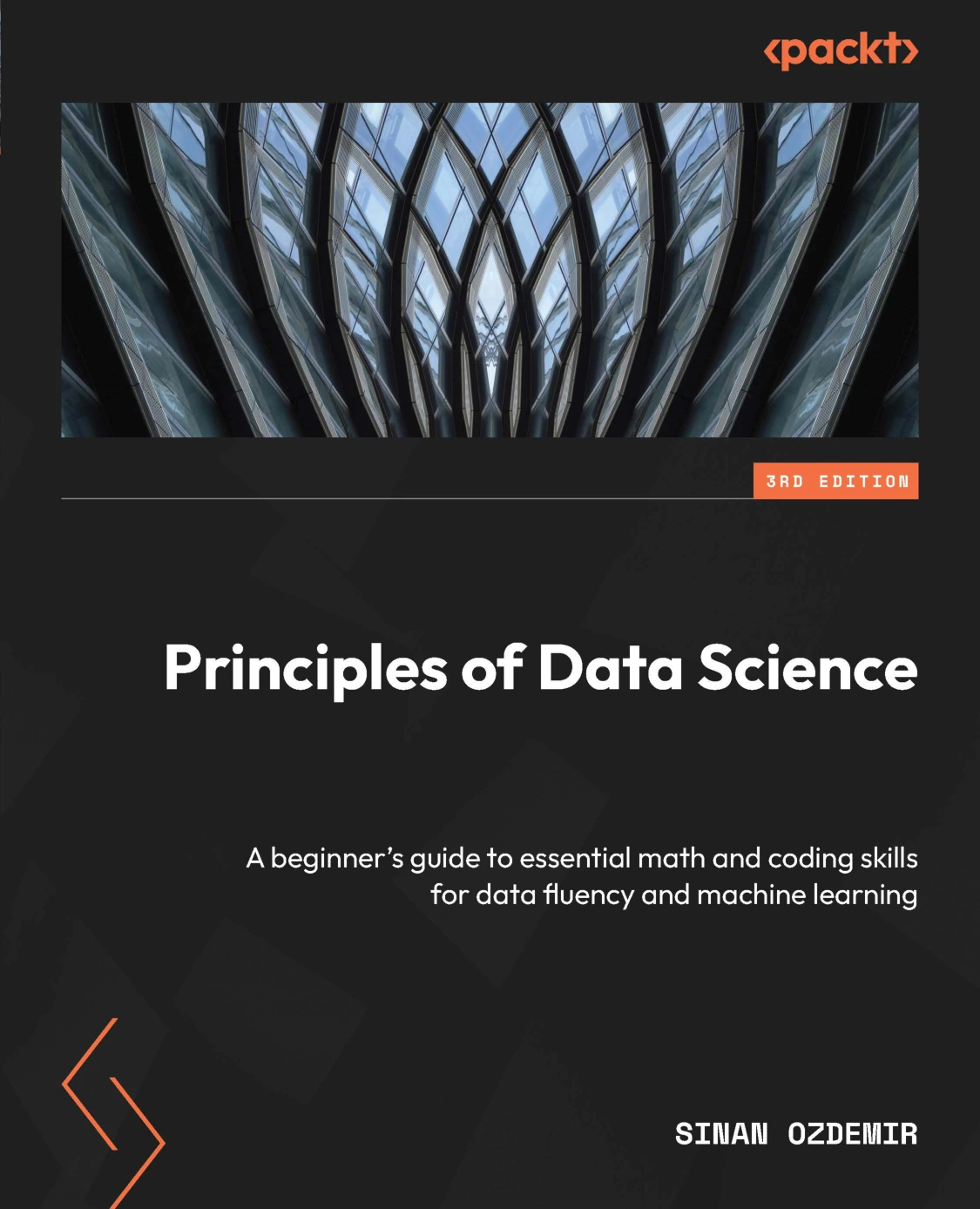
Principles of Data Science: A beginner’s guide to essential math and coding skills for data fluency and machine learning, Third Edition
Original price was: $5.00.$2.50Current price is: $2.50.

Sinan Ozdemir
Product Specs:
- File Type: PDF
- File Size: 29.7 MB
- Book Language: English
- Total Page Count: 326
- Instant Download
Where Math, Code, and Curiosity Meet 📊
Data science can feel like a room with too many doors: statistics through one, programming through another, machine learning through a third. Principles of Data Science, Third Edition by Sinan Ozdemir is built to connect those doorways. Updated for 2024, this beginner-oriented guide lays out the vocabulary, mathematical foundations, and statistical reasoning that make the rest of the field easier to learn.
Instead of treating data science as a collection of disconnected tricks, the book follows a clear learning path from first principles to practical concepts. You meet the terminology, see how different types of data behave, and then work through the math and probability that underpin modern analysis and machine learning.
What the Book Explores 🧠
The early chapters establish the language of the field. Readers encounter the data science Venn diagram, case studies, structured and unstructured data, quantitative and qualitative distinctions, and the four levels of measurement—nominal, ordinal, interval, and ratio. From there, the book outlines a five-step workflow that moves from exploration toward summary and interpretation.
Later chapters turn to the mathematical core. Topics include vectors and matrices, arithmetic symbols, summation, logarithms and exponents, set theory, and linear algebra, including matrix multiplication. Probability follows, with frequentist and Bayesian perspectives, independence, conditional probability, the addition and multiplication rules, complementary events, and Bayes’ theorem.
Probability and Statistics Without the Fog 🧮
Statistics can be where beginners lose momentum. This third edition keeps the focus on understanding. It covers discrete and continuous random variables, sampling, observational and experimental data, measures of center and variation, relative standing, correlation, and the empirical rule. Advanced chapters introduce point estimates, sampling distributions, confidence intervals, hypothesis testing, one-sample t-tests, Type I and Type II errors, and chi-square tests for goodness of fit and association.
By moving through these ideas in sequence, the book helps readers see how probability, statistics, and data manipulation fit together. The goal is not to memorize formulas in isolation, but to build the fluency needed to read, question, and work with data more confidently.
Who This Third Edition Is For
The subtitle describes it plainly: a beginner’s guide to essential math and coding skills for data fluency and machine learning. That makes it a starting point for readers new to the field, including students and professionals who want a foundation before specializing in a particular library, model, or tool. The book’s approach does not assume advanced mathematical training.
Sinan Ozdemir is a former lecturer in data science at Johns Hopkins University and the author of multiple textbooks on data science and machine learning. His experience teaching the subject shapes the book’s patient, explanatory style.
Why the Third Edition
The 2024 third edition updates a title first published in 2016, with a second edition in 2018. For readers who want a current, structured introduction to the mathematical and statistical foundations of data science, it offers a coherent path through a wide field—one concept at a time.
The subtitle also points to coding skills, and the book’s treatment of data structures such as DataFrames and Series connects mathematical ideas to the way data is handled in practice.
User Reviews
Be the first to review “Principles of Data Science: A beginner’s guide to essential math and coding skills for data fluency and machine learning, Third Edition”
You must be logged in to post a review.
Original price was: $5.00.$2.50Current price is: $2.50.






There are no reviews yet.