

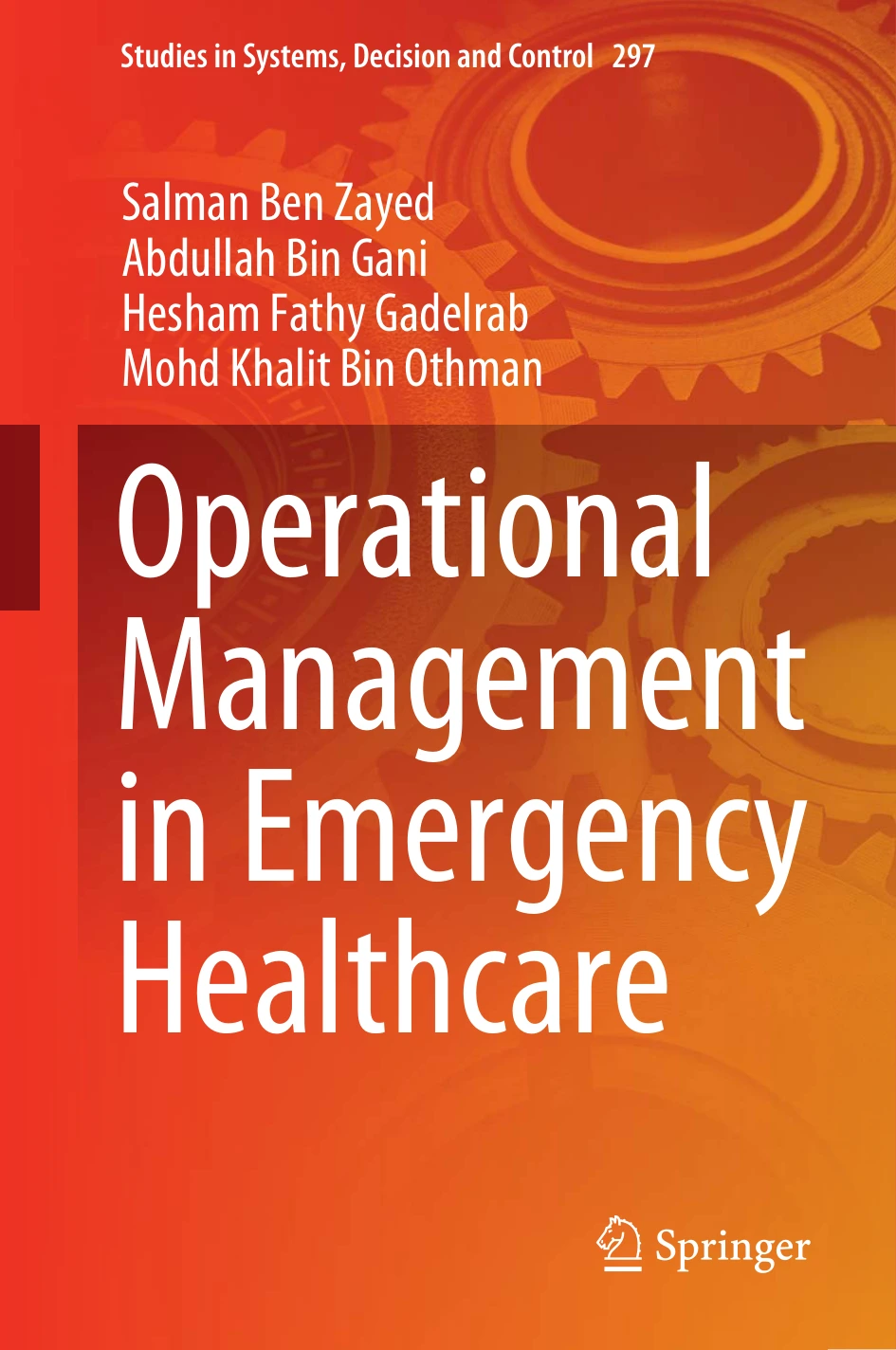
Operational Management in Emergency Healthcare
Original price was: $5.00.$2.50Current price is: $2.50.

Salman Ben Zayed
Product Specs:
- File Type: PDF
- File Size: 4.7 MB
- Book Language: English
- Total Page Count: 198
- Instant Download
Rethinking Emergency Department Operations
Emergency departments are often described as the pressure point of a healthcare system. This Springer monograph treats that pressure as an operational and systems problem: one that can be studied through data, modelling, simulation, and carefully designed decision-support tools. Rather than offering only clinical guidance, Operational Management in Emergency Healthcare looks at how emergency care is organised, measured, and improved when demand, risk, and uncertainty are high.
Published as Volume 297 in the Studies in Systems, Decision and Control series, the book brings together operations management, digital health, and emergency care research. Its focus is the emergency department (ED) as a complex system with waiting times, patient flow, service quality, and decision-making challenges that affect both patients and staff. The authors argue that these challenges require mathematical and analytical models, not only administrative responses.
What the Book Explores
- Systematic review of ED processes and systems research from 2000 to 2019
- Gaps in previous studies of emergency operations and service quality
- Big data, data mining, modelling, and simulation in digital health
- Artificial intelligence and pattern analysis for risk and emergency management
- Service-quality assessment and the development of a decision-support instrument
- Simulation experiments on waiting times and door-to-door service scenarios
Evidence from a Two-Decade Systematic Review
The book reviews two decades of research, from 2000 to 2019, to examine how emergency department operations have been studied and where important questions remain. The review gives special attention to emergency system operations and identifies research gaps, including limited work comparing operational methods for reducing long waiting periods and their effects on patient experience. That review foundation shapes the book’s later modelling and assessment work.
Simulation, Data, and Decision Support
Drawing on big data, data mining, and simulation, the authors explore how analytical models can support decisions in normal and emergency conditions. The book reports that modelled data sets were tested for accuracy using probability density distribution, with 90% of modelled cases not exceeding the optimal range. It also discusses waiting-time reductions in Saudi Arabia and Malaysia, using simulation to compare operational alternatives for emergency department service.
Measuring Emergency Service Quality
A central contribution is the development of a responsive service-quality assessment tool intended to function as a decision-support system. The instrument was validated with a kappa value of 0.763 and a Cronbach’s alpha of 0.827. Those results support the authors’ claim that the tool can deliver valid, reliable data for evaluating healthcare standards.
Why Malaysia and Saudi Arabia Matter in This Research
The literature review found limited research on simulation-model deployment in Malaysia and Saudi Arabia. The authors present their work as the first book to consider this subject for those settings. For readers interested in how emergency operations research translates across different healthcare contexts, these two national examples are a notable part of the book’s contribution.
Who Will Find It Useful
Healthcare managers, emergency department leaders, hospital administrators, health informatics researchers, operations analysts, systems scientists, and graduate students may find the book relevant. It is especially suited to readers who want to connect operational research methods with the practical problems of patient flow, waiting times, service quality, and emergency decision-making.
An Evidence-Based Resource for Complex Care Systems
Operational Management in Emergency Healthcare is a research-oriented title for readers who want more than a surface-level discussion of emergency care management. Its combination of systematic review, service-quality measurement, simulation, and digital-health analysis makes it a focused contribution to the study of emergency department operations.
User Reviews
Be the first to review “Operational Management in Emergency Healthcare”
You must be logged in to post a review.
Original price was: $5.00.$2.50Current price is: $2.50.





There are no reviews yet.