

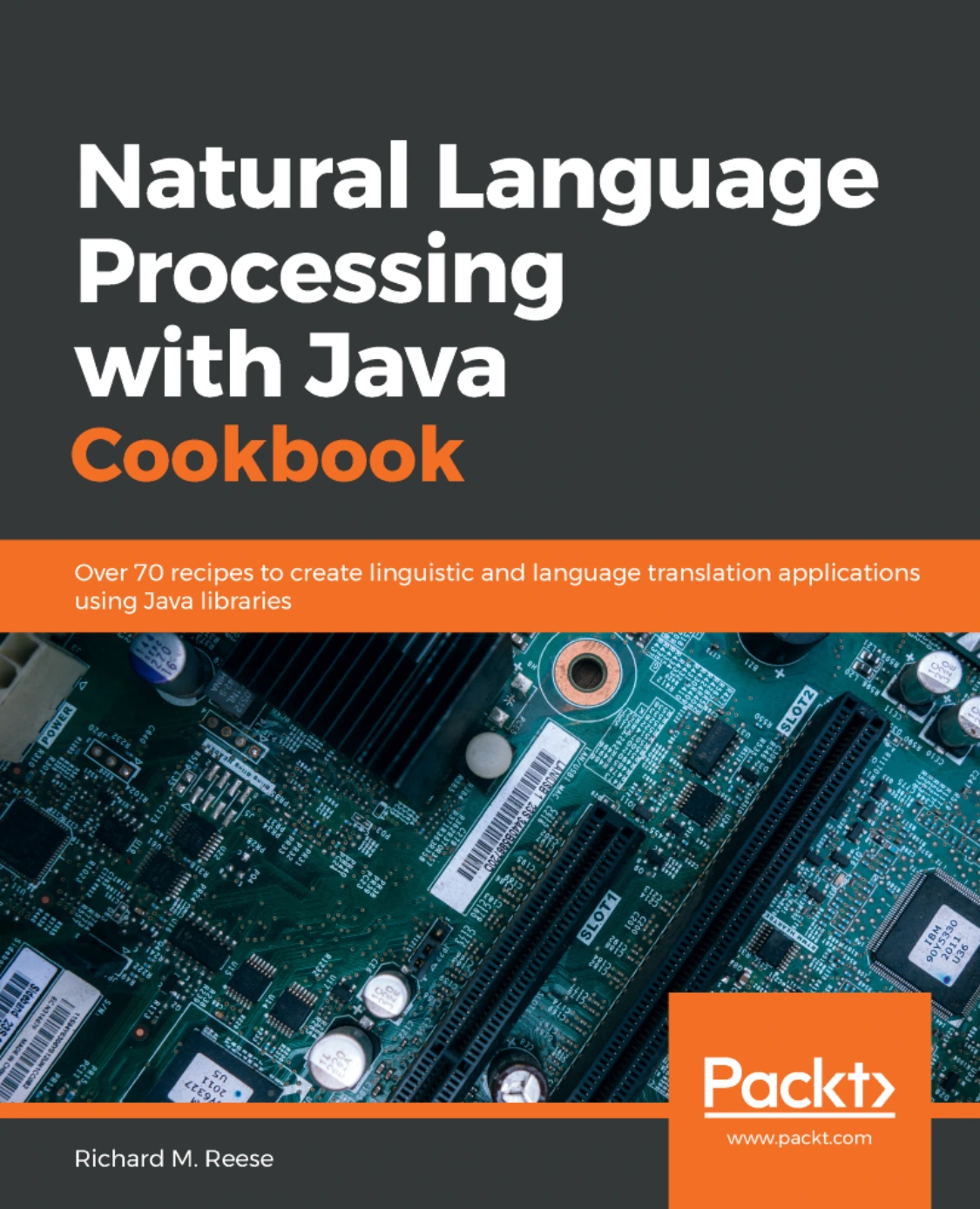
Natural Language Processing with Java Cookbook
Original price was: $5.00.$2.50Current price is: $2.50.

Richard M. Reese
Product Specs:
- File Type: PDF
- File Size: 3.6 MB
- Book Language: English
- Total Page Count: 374
- Instant Download
Seventy-Plus Recipes for Putting Java to Work on Language 💻
Text processing rarely arrives as a tidy, well-behaved problem. You have a document, it is messy, and you need tokens, sentences, names or grammatical categories out of it — usually with an existing Java stack and a deadline attached. Natural Language Processing with Java Cookbook was written for that exact situation. Richard M. Reese gathers more than 70 short, self-contained recipes, each one solving a single concrete linguistic task in Java with widely used open-source libraries.
Published by Packt in April 2019, the book treats language processing as an engineering discipline rather than a theory seminar. If you have ever needed to detect sentence boundaries in clinical notes, train a tagger on domain-specific text, or simply strip stop words before indexing, the recipes here give you a working starting point and an explanation of the machinery underneath.
How the Cookbook Is Organised
Consistency is the quiet strength of this format. Each recipe opens with Getting ready, which sets out the libraries, models and data you need. How to do it walks through the code step by step. How it works then explains why the approach behaves the way it does, so you are not left copying code you cannot reason about. Many entries add There’s more for edge cases and variations, and See also for related techniques elsewhere in the book.
Every chapter also begins with its own technical requirements, so you can tell at a glance whether your environment is ready before you start typing.
Starting with Tokens: Preparing Text for Analysis 🧩
Everything downstream depends on how you cut text apart. The opening chapter works through tokenization using the Java SDK, then moves to OpenNLP and a maximum entropy approach. It does not stop at off-the-shelf tools: there is a recipe for training a neural network tokenizer when your text is specialised enough that general models struggle.
From there the book turns to word-level meaning — identifying stems, training an OpenNLP lemmatization model, determining a word’s lexical meaning, and removing stop words with LingPipe. These are unglamorous steps, but they shape the quality of everything that follows.
Splitting Documents into Sentences
Sentence boundary detection sounds trivial until you meet an abbreviation, a decimal point or a Twitter-style fragment. The book compares several routes to the same goal: the Java core API, the BreakIterator class, OpenNLP, the Stanford NLP API, and LingPipe combined with chunking. Two recipes address specialised text directly, including training a neural network to handle material where conventional rules break down.
Finding Entities, Not Just Words
Named entity recognition moves the work from surface strings to meaning. Regular expressions provide the entry point, first alone and then combined with chunks. OpenNLP recipes follow, along with a recipe for isolating multiple entity types in one pass.
Statistical approaches get their own space too: a conditional random field model for entity detection within a document, a chunker-based alternative, and a recipe for training a specialised NER model tuned to your own domain vocabulary.
Parts of Speech, from Dictionaries to Neural Networks
Part-of-speech tagging gets a thorough treatment across a wide range of methods. You will find straightforward tagging, chunker-based POS detection, dictionary-driven tagging, and the Penn Treebank tag set. A recipe on textese tackles informal, abbreviated language that standard taggers were never designed for.
More advanced options include building a tagging pipeline, using a hidden Markov model, and training a specialised POS model when generic accuracy is not good enough.
Libraries and Models You Will Work With
- The core Java SDK and API, including BreakIterator
- Apache OpenNLP for tokenization, sentence detection, lemmatization, NER and POS tagging
- LingPipe for stop-word removal, chunking and boundary detection
- The Stanford NLP API
- Statistical and neural techniques: maximum entropy, conditional random fields, hidden Markov models and trained neural network models
Because each recipe names its dependencies up front, the book doubles as a map of the Java NLP ecosystem — useful if you are deciding which library deserves a place in your project.
Who Gets the Most from This Book
This is a working developer’s cookbook. It assumes you can read and write Java, configure a project and run it, but it does not assume any background in linguistics. Backend developers, data engineers, search and information-retrieval specialists, and computer science students building a first text-processing pipeline will all find material they can apply directly.
Teachers and researchers who need reproducible, code-level examples of classic NLP tasks will also find the recipe structure convenient for demonstration and adaptation.
About Richard M. Reese
Richard M. Reese has spent his career on both sides of the classroom. He worked for 17 years in the telephone and aerospace industries across research and development, software development, supervision and training, and now teaches at Tarleton State University. He has written several Java books covering topics such as EJB 3.1, Java 7 and 8 updates, certification, jMonkeyEngine, functional programming, networks and data science, and is known for a concise, easy-to-follow approach to technical material.
Add It to Your Shelf
If your work involves text and your language of choice is Java, this cookbook earns its place as a reference you will return to task by task rather than read once and shelve. 📚 Available as a digital edition from Digital Delights.
User Reviews
Only logged in customers who have purchased this product may leave a review.
Original price was: $5.00.$2.50Current price is: $2.50.
There are no reviews yet.