

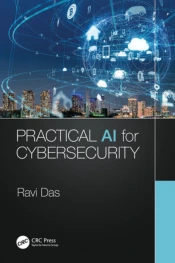
Practical AI for Cybersecurity
Original price was: $5.00.$2.50Current price is: $2.50.

Ravi Das
Product Specs:
- File Type: PDF
- File Size: 17.3 MB
- Book Language: English
- Total Page Count: 293
- Instant Download
Practical AI for Cybersecurity: Where Machine Learning Meets Modern Defense 🔐
Security teams are asked to do more than ever: monitor endless threat feeds, respond to alerts, test systems, and somehow anticipate what attackers will try next. Ravi Das takes that reality as the starting point for Practical AI for Cybersecurity, a technical guide to using artificial intelligence, machine learning, computer vision, and neural networks in defensive security work.
The book is not a collection of vague predictions about AI. It works through the concepts, algorithms, and workflows that security professionals need to understand when evaluating or building AI-assisted tools.
Why AI Is Changing the Security Playbook
Das begins with the evolution of cybersecurity and the growing burden on IT security teams. As threat variants multiply, manually analysing intelligence feeds and modelling future attacks becomes slow and labour-intensive. AI offers a way to automate routine analysis and detection tasks, giving analysts more time to investigate unknown vulnerabilities and develop patching recommendations.
Inside the Book 🧠
The material moves from foundational ideas to applied techniques. Readers encounter:
- The history and sub-fields of artificial intelligence
- Data basics, data preparation, and the role of data in AI systems
- The machine learning process, from algorithm selection to training, evaluation, and fine-tuning
- Probability, Bayesian methods, and statistical concepts used in machine learning
- Supervised and unsupervised learning, decision trees, Naïve Bayes, density estimation, and Gaussian mixture models
- Perceptrons, multi-layer perceptrons, backpropagation, and nonlinear regression
- Endpoint protection, malware detection, feature selection, CVE analysis, and API/system-call inspection
Machine Learning Concepts in Context
Rather than treating algorithms as abstract mathematics, the book connects them to security problems. Discussions of feature engineering and malware classification, for example, show how model design choices affect the detection of malicious activity. The treatment of receiver operating characteristic curves and model tuning helps readers understand how classification performance is measured and improved.
Python, Chatbots, and Worked Examples 💻
Several sections use Python to demonstrate machine learning in practice. Examples include a diabetes testing portal chatbot and a stock price prediction project, which illustrate data acquisition, GUI construction, sentiment analysis, linear regression, moving averages, and plotting. These projects give technical readers a sense of how AI components fit together in working applications.
Who Will Get the Most from This Book
The book is aimed at security practitioners, IT professionals, and technically minded readers who want to understand how AI can support cyber defence. It is especially relevant for those involved in penetration testing, threat hunting, malware analysis, or security operations who need a deeper grasp of the machine learning methods increasingly appearing in security tools.
A Practical Guide for an Evolving Threat Landscape
Practical AI for Cybersecurity balances conceptual explanation with applied examples. It gives readers a structured way to think about AI’s role in security, while keeping the focus on the operational problems that security teams face every day.
User Reviews
Only logged in customers who have purchased this product may leave a review.
Original price was: $5.00.$2.50Current price is: $2.50.


There are no reviews yet.