

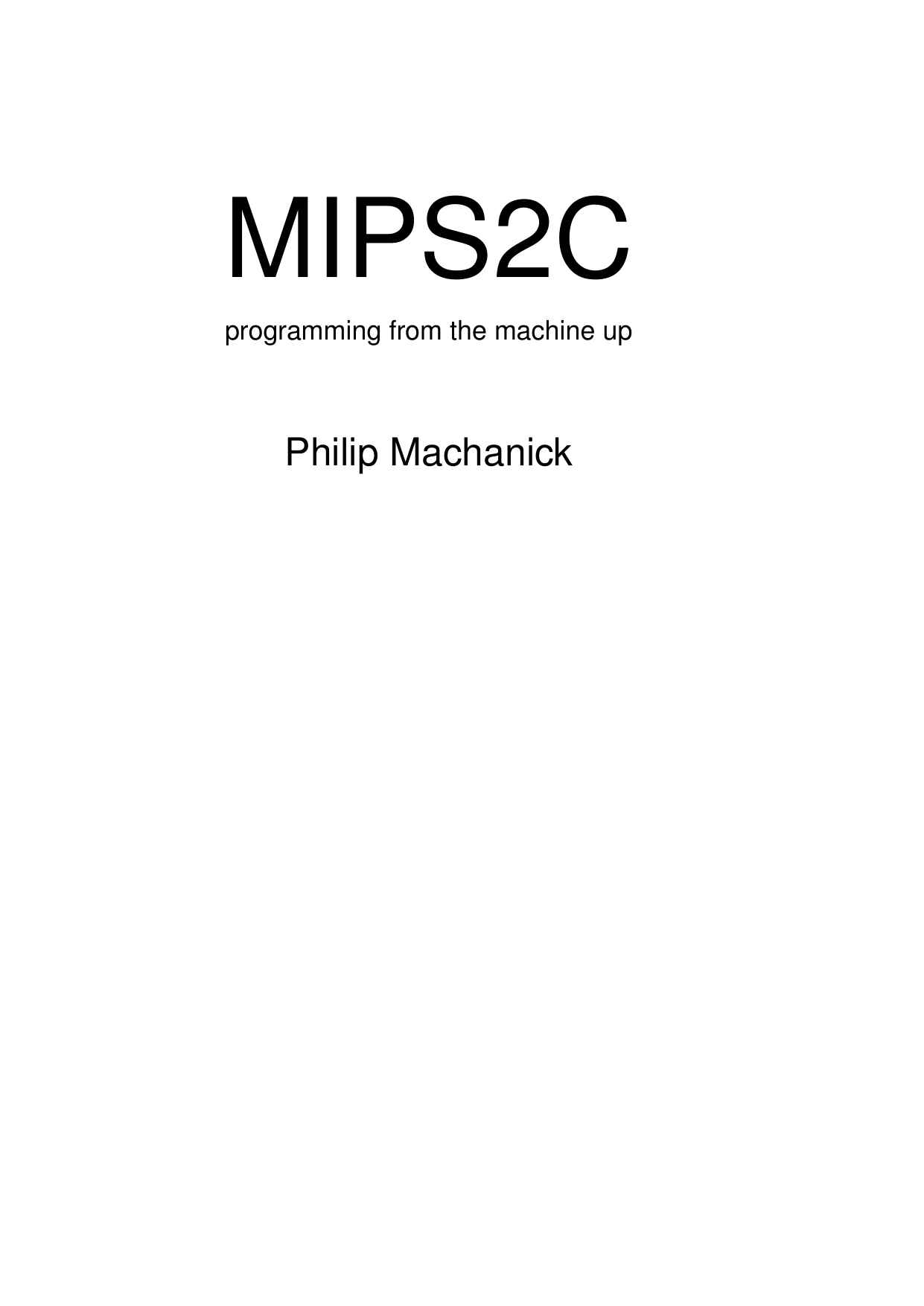
MIPS2C: Programming from the Machine Up
Original price was: $150.00.$75.00Current price is: $75.00.

Philip Machanick
Product Specs:
- File Type: PDF
- File Size: 5.2 MB
- Book Language: English
- Total Page Count: 347
- Instant Download
From Machine Code to C, Step by Step 💻
MIPS2C: Programming from the Machine Up is a practical computer science textbook that treats assembly language as a way to understand what C programs actually do. Rather than starting at a high level and treating the machine as an abstraction, Philip Machanick builds the reader’s mental model from the bottom up: machine language, instruction sets, number representation, MIPS assembly, memory, functions, and data structures.
Why Start at the Assembly Level? ⚙️
Many programming courses begin with high-level languages, which makes it easy to produce visible results but can leave a gap in understanding. This book argues that starting closer to the machine helps students internalize the programming model they will need later. The material is designed to show how high-level constructs such as loops, conditionals, functions, arrays, and objects are implemented at the assembly level.
What the Book Covers
- Machine language versus high-level language, and how code is translated
- Numbers, logic, and the representation of data in a computer
- MIPS assembly by example: instruction formats, memory access, ALU operations, and floating point
- Memory and functions: calling conventions, global and local variables, the call stack, and parameter passing
- Data structures: machine-level data, dynamic data, structured types, and putting it all together
- Performance: algorithmic choices, the memory hierarchy, input/output, and energy and mobility
- C from the ground up: program structure, files, major constructs, multifile programs, and command-line work
Who This Book Is For
The author writes for students who already have a year of programming experience, especially those coming from an object-oriented background. It can also suit readers who want a deeper understanding of computer organization and low-level programming without diving into hardware design. The focus is on assembly-level programming as it relates to C, making it a useful bridge for courses in computer organization, systems programming, or compilers.
A Teaching Approach Built Around Templates
Instead of presenting every detail at once, the book introduces coding templates for statements such as if statements and loops, then gradually adds the requirements for full generality. C is used deliberately as a familiar pseudocode in the early sections, helping readers connect syntax they know to the assembly they are learning. The call stack is presented as a set of conventions that can be changed, not as a fixed structure in memory.
Reference Material and Appendices
Appendices provide quick access to the ASCII character set, MIPS register conventions, SPIM system calls, the SPIM call stack, and background on SPIM and the MIPS R2000. These sections make the book useful as a lab companion as well as a course text.
Understanding What Happens Underneath 🧠
By the end, readers should be better prepared to understand compilers, recursion, and data structures through direct exposure to the machine-level mechanisms that support them. The book is published by RAMpage Research under a Creative Commons Attribution-NonCommercial 4.0 International licence, reflecting the author’s aim to keep learning materials more affordable.
User Reviews
Only logged in customers who have purchased this product may leave a review.
Original price was: $150.00.$75.00Current price is: $75.00.

There are no reviews yet.