

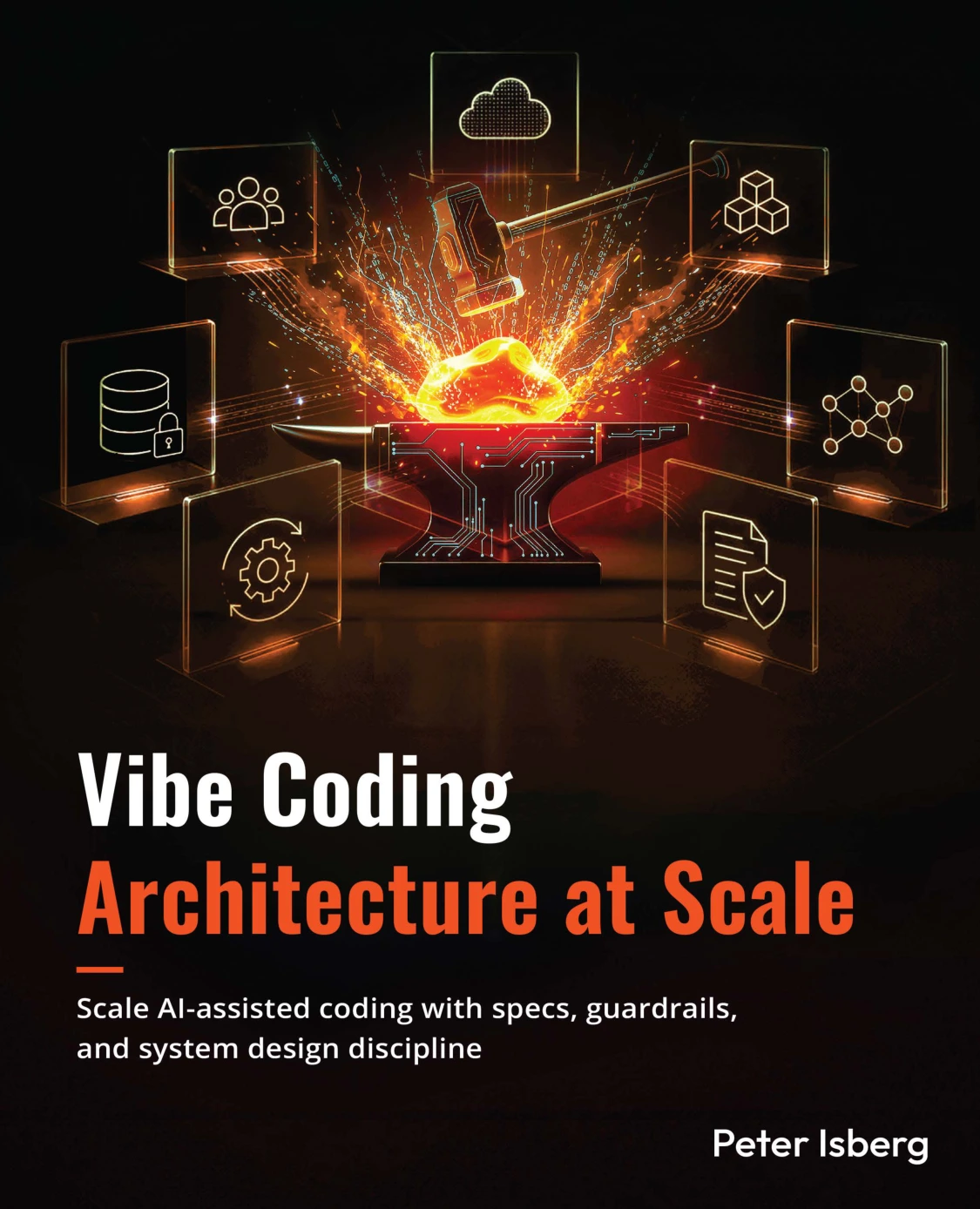
Vibe Coding Architecture at Scale
Original price was: $5.00.$2.50Current price is: $2.50.

Peter Isberg
Product Specs:
- File Type: PDF
- File Size: 79.1 MB
- Book Language: English
- Total Page Count: 570
- Instant Download
When AI writes faster, architecture matters more 💻
AI-assisted coding has collapsed the time it takes to produce a feature. But speed creates a new problem: the code accumulates faster than the team can understand or shape it. Peter Isberg’s Vibe Coding Architecture at Scale tackles that gap directly, laying out a practical system for steering generated code toward maintainable, testable, and intentional architecture.
The book opens with what Isberg calls the ‘Paradox of Speed.’ More output does not automatically mean more reliable software. Instead, the Jevons effect applies: as generation becomes cheaper, appetite for more code grows, and complexity sprawls. The solution is not to forbid AI assistance but to engineer guardrails that move at the same velocity as generation.
Part I: The entropy of the prompt
Early chapters diagnose why AI naturally creates spaghetti architectures. Context windows get bloated, instructions drift, and code that looks correct can hide structural debt. Isberg introduces context diets, context graphs, and a three-tier model of standing context. He explains how to balance token budgets, caching, and attention without starving the model of the information it needs.
The discussion then expands into a full configuration surface: memory, skills, subagents, and hooks. These primitives give developers control over what the agent knows, when it learns, and when deterministic automation should step in.
Part II: Engineering the guardrails ⚙️
The second half moves from diagnosis to enforcement. Annotation-driven design places guardrails directly in source code, so AI output is checked at compile time rather than relying on human review alone. Architectural unit testing with tools like ArchUnit and Spring Modulith turns boundaries into assertions. Static analysis closes gaps that tests miss—error-prone patterns, nullability contracts, duplicate code, and convention drift.
A dedicated chapter on test topology addresses the reality of machine-speed feedback: tests must be isolated, parallelizable, and fast. The author presents a checklist covering budgets, containers, database isolation, and coverage strategy. He also introduces AI-native design patterns, including spec-implementation separation, interface-first development, and feature locality, that reduce context waste and make generated code easier to review.
Visualizing, logging, and documenting the system
Because mental models fall behind generated code, Isberg treats diagrams as build outputs. Spring Modulith can generate architectural diagrams from tests, and PlantUML or Mermaid keeps those diagrams in text form, reviewable and diffable. Logging becomes a feedback loop for agents, with levels treated as a budget rather than a vocabulary. Documentation—especially README,,, and an index router—turns into load-bearing infrastructure for AI-assisted teams.
Who will get the most from this book
This ebook is aimed at experienced software engineers, architects, and technical leads who already use or plan to use AI coding assistants. It assumes comfort with Java-adjacent tooling and architectural vocabulary, but the principles transfer to other stacks. If you are responsible for the long-term health of a codebase that is now being accelerated by AI, this material is directly actionable.
Digital Delights offers this title as a DRM-free ebook for developers who want to read, search, and apply the techniques without platform lock-in.
From fast chaos to designed speed
Rather than slowing AI down, the author shows how to direct its output with clear contracts, tested boundaries, and a disciplined context strategy. Vibe Coding Architecture at Scale is a field manual for the moment when coding speed stopped being the bottleneck and architecture became the differentiator.
User Reviews
Be the first to review “Vibe Coding Architecture at Scale”
You must be logged in to post a review.
Original price was: $5.00.$2.50Current price is: $2.50.



There are no reviews yet.