

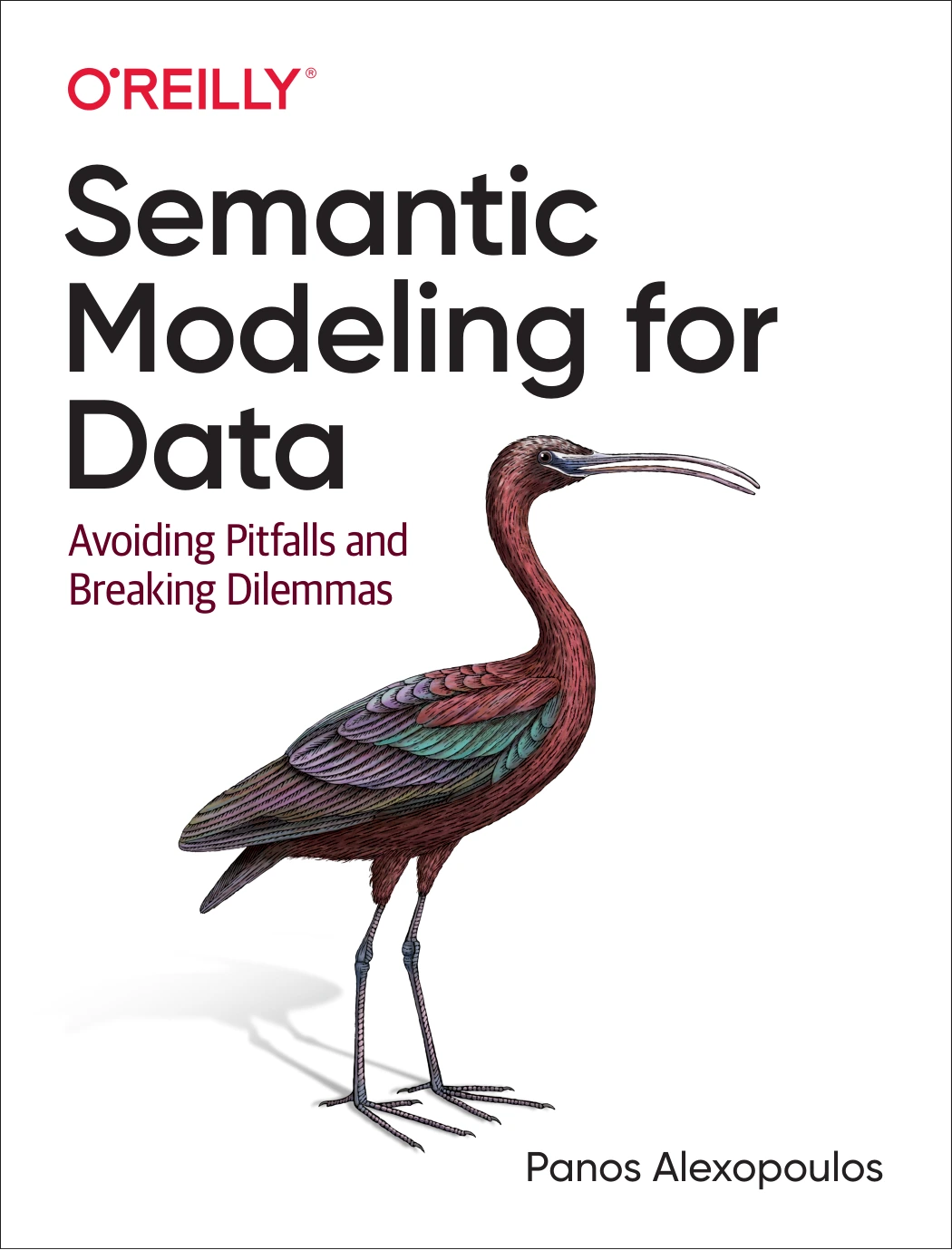
Semantic Modeling for Data: Avoiding Pitfalls and Breaking Dilemmas
Original price was: $5.00.$2.50Current price is: $2.50.

Panos Alexopoulos
Product Specs:
- File Type: PDF
- File Size: 9.0 MB
- Book Language: English
- Total Page Count: 329
- Instant Download
See Semantic Modeling from the Data Practitioner’s View
Data models are supposed to make meaning explicit, but anyone who has worked with enterprise metadata knows how easily vague labels, inconsistent subclasses, and poorly chosen relations creep in. Semantic Modeling for Data tackles that reality head-on, offering a practical guide to building models that actually work for people, systems, and organizations.
Panos Alexopoulos steers clear of purely academic abstraction. Instead, he examines the everyday decisions that cause semantic models to fail: confusing class-subclass relations with part-whole relations, measuring quality with arbitrary thresholds, treating vagueness as a bug rather than a feature, and letting flawed assumptions go undocumented. The result is a book that feels like sitting down with an experienced modeler who has seen the mistakes and is willing to explain why they happen.
What Makes This Book Different
Rather than cataloging every possible formalism, this ebook focuses on the choices that matter most in real projects. You find practical discussion of how to name entities clearly, write definitions that reduce ambiguity, handle identity criteria, manage open-world assumptions, and align semantic models with actual business needs.
Key themes include:
- Building sound semantic structures with entities, relations, classes, and constraints
- Detecting and describing vagueness instead of forcing false precision
- Avoiding bad subclasses, bad axioms, and misleading inference rules
- Linking model quality to concrete risks and benefits rather than abstract scores
- Improving entity resolution and semantic relatedness through better knowledge design
- Developing a realistic organizational strategy for semantic modeling
Pitfalls and Dilemmas, Clearly Explained
The book is organized to help you first understand the basics, then recognize where things go wrong. Early chapters lay a foundation in semantic and linguistic phenomena such as ambiguity, rigidity, symmetry, and transitivity. Later chapters work through common pitfalls in naming, definitions, subclasses, axioms, specifications, and knowledge acquisition. The final sections tackle quality trade-offs, entity resolution, semantic relatedness, and strategic challenges that go beyond the technical model itself.
Alexopoulos does not pretend there is always one right answer. Instead, he shows how different contexts demand different choices and how a model that is perfect for one use case can be dangerously wrong for another. That honest, trade-off-centered perspective is one of the book’s greatest strengths.
Who Will Find It Useful
If you design knowledge graphs, build ontologies, manage metadata, or integrate data across systems, this ebook will sharpen your judgment. It is especially relevant for information architects, data engineers, taxonomists, and analysts who need to make semantic decisions under real-world constraints. The content is technical but approachable, with plenty of examples and concrete guidance.
A Reference You Will Return To
Because the pitfalls are organized clearly and the advice is grounded in practice, Semantic Modeling for Data works both as a cover-to-cover read and as a reference when a modeling question comes up. Keep it close when you are designing a new model, reviewing an existing one, or trying to explain to stakeholders why a particular modeling choice matters.
This is the kind of book that makes you look at a data dictionary or class hierarchy and immediately start asking sharper questions.
User Reviews
Be the first to review “Semantic Modeling for Data: Avoiding Pitfalls and Breaking Dilemmas”
You must be logged in to post a review.
Original price was: $5.00.$2.50Current price is: $2.50.



There are no reviews yet.