

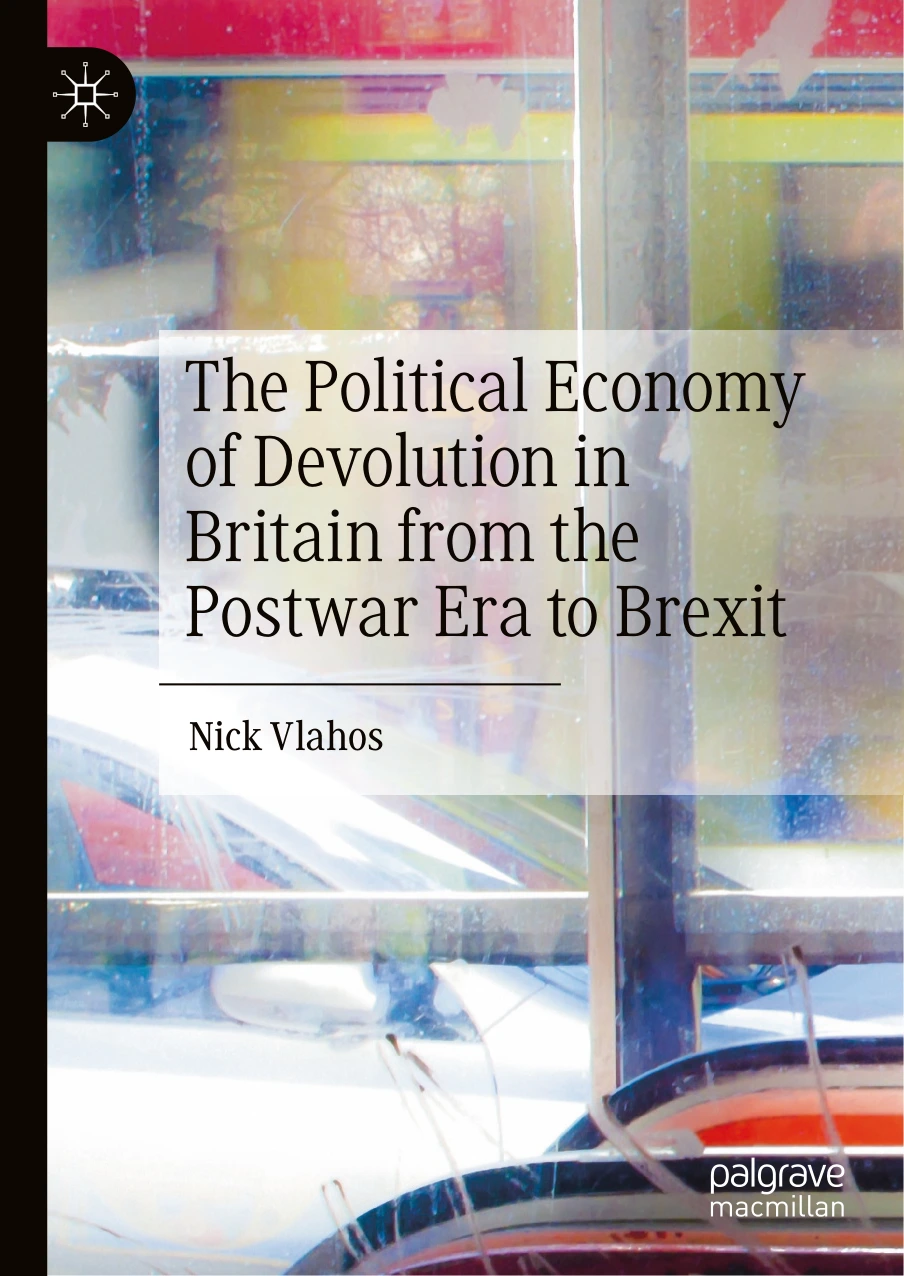
The Political Economy of Devolution in Britain from the Postwar Era to Brexit
Original price was: $5.00.$2.50Current price is: $2.50.

Nick Vlahos
Product Specs:
- File Type: PDF
- File Size: 3.2 MB
- Book Language: English
- Total Page Count: 271
- Instant Download
Understanding Devolution as a Political and Economic Struggle
Devolution in Britain is often treated as a constitutional question, but Nick Vlahos shows that it is also a deeply political-economic story. This book traces how struggles over state power, economic development, and spatial inequality produced the devolved institutions that now shape everyday life across England, Scotland, and Wales. Rather than offering a narrow institutional account, Vlahos places devolution within a broader framework of scale: the shifting distribution of political, economic, and democratic authority across national, regional, and local levels.
A Postwar History Told in Three Movements
The analysis moves from the national-level commitments of 1945–1970 through the conflicts of 1970–1997 and into the era of devolution after 1997. It then carries the story forward to the sub-regional initiatives and fiscal debates that unfolded between 2010 and 2020, ending with a chapter on democracy and the political economy of scale. This periodization helps readers see devolution not as a single event, but as an ongoing process of territorial management shaped by partisan competition and capitalist development.
Scale, Partisanship, and the Uneven Geography of Britain
Vlahos pays careful attention to the divergent political cleavages and economic trajectories that distinguish English regions, Scotland, and Wales. He argues that contemporary devolution cannot be understood without examining the uneven spatial economic underpinnings of British territorial management. The book draws on critical institutionalism, democratization research, and economic geography to explain why decentralization happens at particular moments—and who benefits from the design of new governance structures.
What the Research Covers
- The relationship between decentralization, devolution, and the political economy of scale
- Postwar national-level commitments and the shift toward regional planning after 1945
- Class actors, partisan coalitions, and the struggle over fiscal and political power
- Devolution as a scale commitment under New Labour and its aftermath
- Sub-regional governance, city-region deals, and local economic development after 2010
- The democratic implications of rescaling the state in Britain
Why This Perspective Matters
By synthesizing research from British history, economic geography, urban planning, and political science, the book builds a conversation across specializations that are too often kept separate. Vlahos avoids easy conclusions, instead showing how competing interests—fractions of capital, labour movements, local officials, and national elites—coalesce around regionally rooted coalitions. This attention to political struggle makes the book valuable not only for scholars of devolution but also for anyone interested in the future of British governance after Brexit.
Who Will Find This Ebook Valuable
Researchers and postgraduate students in political science, public policy, economic geography, and British history will find the book a rigorous and original contribution. It is also relevant for policy practitioners, journalists, and engaged readers who want a deeper understanding of why devolution took the form it did—and why the territorial structure of the British state remains so contested.
User Reviews
Be the first to review “The Political Economy of Devolution in Britain from the Postwar Era to Brexit”
You must be logged in to post a review.
Original price was: $5.00.$2.50Current price is: $2.50.



There are no reviews yet.