

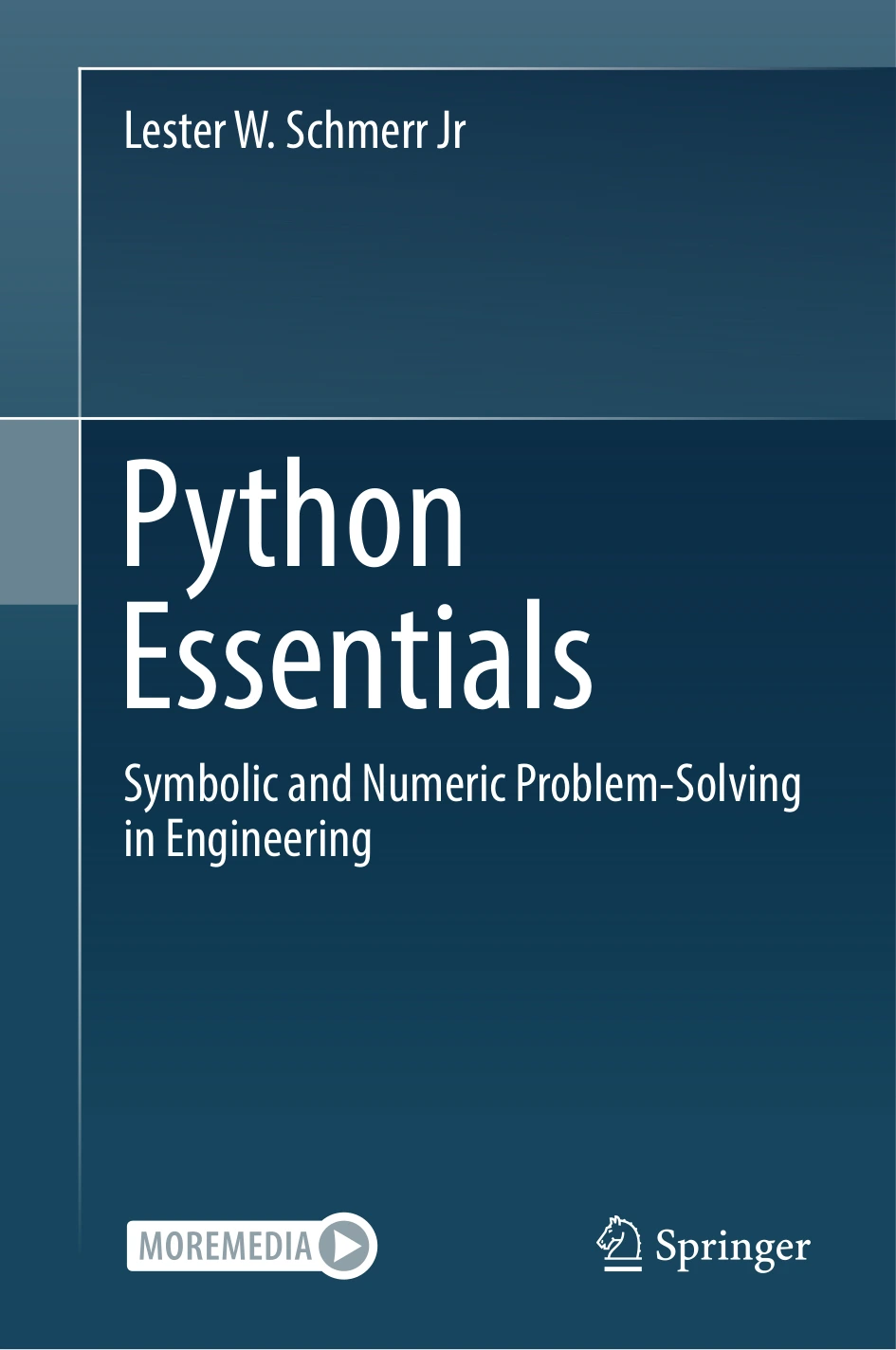
Python Essentials: Symbolic and Numeric Problem-Solving in Engineering
Original price was: $5.00.$2.50Current price is: $2.50.

Lester W. Schmerr Jr
Product Specs:
- File Type: PDF
- File Size: 10.9 MB
- Book Language: English
- Total Page Count: 355
- Instant Download
Python as an Engineering Calculator 🧮
Most Python guides focus on writing programs. Python Essentials starts from a different question: how can Python work like a scientific calculator for engineering and science? The answer runs through the entire book. Using the Spyder IDE, the text shows how to enter commands in the IPython Console, inspect objects in the Variable Explorer, and call on NumPy, SymPy, SciPy, and Matplotlib without getting lost in a maze of modules.
The approach is direct but not simplistic. It builds a consistent interactive environment — a “Python calculator” — so numerical work, symbolic work, and plotting can sit side by side.
What the Book Covers
Across eight chapters and an appendix, the material moves from language fundamentals to applied engineering methods:
- Variables, arrays, complex numbers, functions, and control statements
- Vectors, dot and cross products, direction cosines, and geometric interpretation
- Matrices, determinants, inverses, and eigenvalue problems
- Numerical and symbolic solutions of linear equations, including overdetermined and underdetermined systems
- Root-finding and simultaneous nonlinear equations
- Ordinary differential equations with Runge–Kutta solvers and symbolic methods
- Plotting, specialized plots, 3-D visualization, and animation
- Finite-difference solutions of the 1-D wave equation and 1-D heat equation
Inside the Spyder Workflow 💻
Spyder is not just a backdrop here; it shapes how problems are solved. The IPython Console acts as the keyboard and display, the Variable Explorer makes data structures visible, and the scientific libraries are imported in a way that keeps function calls close to calculator style. That setup reduces friction when testing an equation, checking a matrix, or plotting a result.
The book also tackles a practical difficulty: Python’s modularity can be overwhelming when multiple packages offer similar tools. A central strategy renames functions when necessary and adds engineering-friendly helpers, giving readers a repeatable starting point for each session.
Engineering Examples That Reveal the Unexpected
Examples and exercises draw from engineering dynamics, structures, and wave propagation. The spring-pendulum motion in the ordinary differential equations chapter is used to show how numerical solutions can uncover motions that are not obvious from a quick inspection. In the finite-difference chapter, the wave equation discussion includes boundary conditions and an absorbing boundary that lets waves pass through without reflection. The heat equation section follows temperature changes in a wall until a steady state emerges.
These are not abstract demonstrations. They show how Python can be used to explore physical behavior, test numerical schemes, and visualize results through animations.
Exercises and Companion Materials
Every chapter ends with exercises designed to reinforce the topics and build familiarity with the interactive workflow. An Exercise Solutions Manual with detailed solutions, along with the Python functions and scripts described in the text, is available from the publisher. For readers who want to check their work or adapt the code, those materials extend the book beyond its printed pages.
Who Will Find It Useful
The primary audience is engineering students, but the method also suits practicing engineers, researchers, and students in other technical or scientific disciplines. If you already know some Python and want to use it more directly for numerical and symbolic problem-solving, this book offers a structured path. If you are new to Python but comfortable with technical mathematics, the calculator-like approach gives you a focused way in.
Python Essentials is best understood as a problem-solving companion: a guide to setting up Python so it becomes a responsive tool for engineering analysis, not just another language to learn.
User Reviews
Only logged in customers who have purchased this product may leave a review.
Original price was: $5.00.$2.50Current price is: $2.50.


There are no reviews yet.