
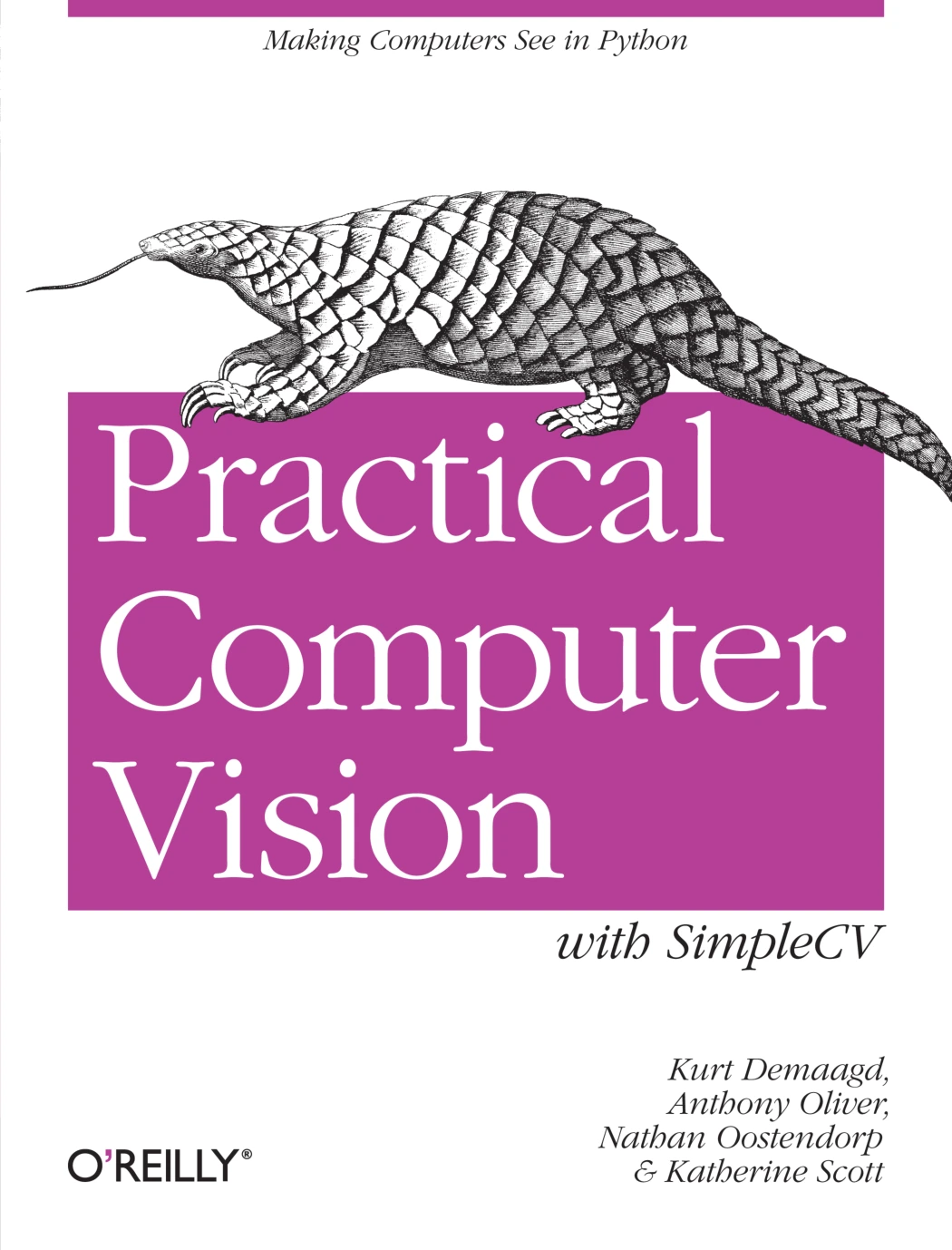
Practical Computer Vision with SimpleCV
Original price was: $5.00.$2.50Current price is: $2.50.

Kurt Demaagd
Product Specs:
- File Type: PDF
- File Size: 42.2 MB
- Book Language: English
- Total Page Count: 254
- Instant Download
See the World Through Code 📷
Computer vision can feel like a magic trick: pixels go in, and somehow a program finds a face, tracks a ball, or reads a barcode. Practical Computer Vision with SimpleCV shows how that magic actually works. Written for Python programmers who want to teach machines to see, this O’Reilly guide uses SimpleCV – a framework built to make vision experiments faster, clearer, and far less intimidating.
The book starts with the essentials: what computer vision is, how a vision system is put together, and how SimpleCV fits into the Python ecosystem. From there, it moves steadily into hands-on territory, always keeping the focus on getting something working.
What SimpleCV Makes Possible
SimpleCV wraps complex image-processing operations in an approachable Python API. That means you can spend less time wrestling with low-level libraries and more time asking interesting questions: Can I detect a specific color? Track motion? Measure an object? Build a photo booth? The framework is designed for exactly that kind of rapid experimentation, and the book follows suit.
From Camera to Code: Core Techniques 💻
The chapters build a practical foundation across the vision pipeline. You will explore:
- Installing SimpleCV and using its interactive shell
- Working with live cameras, image sets, video, Kinect, and networked IP cameras
- Understanding pixels, bitmaps, scaling, cropping, and geometric transforms
- Color spaces, segmentation, binarization, dilation, and erosion
- Drawing, layers, text, and custom display objects
- Finding blobs, lines, circles, and corners
- Manipulating feature sets, measuring objects, and tracking movement
- Template matching, optical flow, Haar-like features, and barcode detection
Each concept is tied to code and to a visual result, so abstract ideas become observable behavior.
Projects That Turn Concepts into Practice
The examples are not filler. They include time-lapse photography, a photo booth application, Kinect-based segmentation and measurement, green-screen chroma keying, motion blur effects, a moving target tracker, a circle-tracking ball demo, a barcode scanner, and even a playful mustache overlay. These projects illustrate how individual techniques combine into working vision systems, and they give readers a base to adapt for their own ideas.
Who This Book Is For
If you already know some Python, you can follow along without prior computer vision experience. The authors introduce vocabulary and concepts as needed, so beginners can build confidence while experienced programmers can move quickly to the parts they need. Educators, hobbyists, and developers prototyping camera-based applications will find the project-driven structure especially useful.
Why Practical Computer Vision Still Matters
Cameras are everywhere, and the ability to process what they capture is valuable across robotics, security, automation, medical imaging, and creative coding. This book captures an important moment when accessible tools like SimpleCV opened the door for more people to experiment with vision. The techniques and mindset remain relevant for anyone learning to connect code to the physical world.
Start Building Your Own Vision Systems
Practical Computer Vision with SimpleCV is a clear, example-rich invitation to look at images as data and at cameras as sensors you can program. If you have been curious about computer vision but did not know where to begin, this guide offers a friendly and practical starting point.
User Reviews
Only logged in customers who have purchased this product may leave a review.
Original price was: $5.00.$2.50Current price is: $2.50.

There are no reviews yet.