

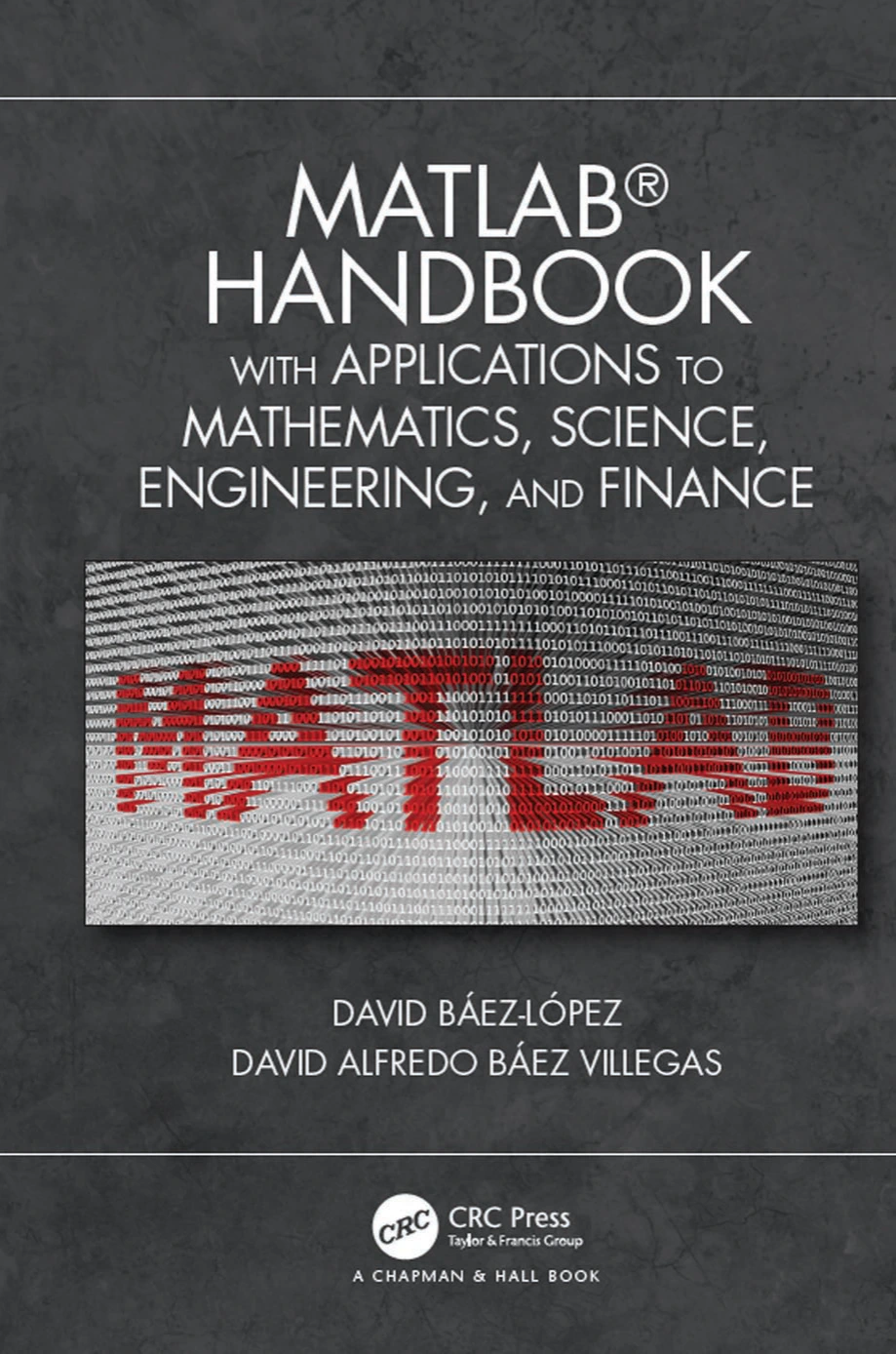
MATLAB® Handbook with Applications to Mathematics, Science, Engineering, and Finance
Original price was: $5.00.$2.50Current price is: $2.50.

José Miguel David Báez-López
Product Specs:
- File Type: PDF
- File Size: 29.6 MB
- Book Language: English
- Total Page Count: 383
- Instant Download
MATLAB for Real Work Across Technical Fields 💻
MATLAB is more than a calculator. It is a full environment for numerical computation, data analysis, visualization, and model-based design. This handbook is written for readers who want to use it with confidence—whether you are a student tackling a first engineering course, a researcher analyzing experimental data, or a professional building financial models.
What the Handbook Covers
The book moves in a clear arc from fundamentals to applied projects. Early chapters introduce the MATLAB interface, basic calculations, variables, and input/output. From there, it builds through plotting in two and three dimensions, symbolic math, polynomials, curve fitting, and equation solving. The middle sections cover matrices and linear algebra, calculus, differential equations, programming with m-files, object-oriented programming, graphical user interfaces, and Simulink.
Core Skills, Built Step by Step 🧮
Each core topic is presented with MATLAB commands and examples that show how the software behaves. You will find coverage of:
- Elementary functions, variable types, and saving sessions
- 2D and 3D plots, polar plots, histograms, and contour plots
- Polynomials, cubic spline fitting, and the Basic Fitting tool
- Matrix operations, dot and cross products, LU factorization, and eigenvalues
- Limits, derivatives, integration, and numerical solutions of differential equations
- Control structures, functions, file management, and publishing m-files
- Classes, inheritance, methods, and overloading in MATLAB
- GUIDE-based GUI creation and Simulink modeling
Applications That Show MATLAB in Action 📊
The final chapters turn to domain applications, showing how the same MATLAB environment supports very different kinds of problems. You will find examples in signals and systems, digital signal processing, control systems, chemical engineering, food engineering, civil engineering, and mechanical engineering. Physics chapters cover kinematics, dynamics, astronomy, electricity and magnetism, optics, and modern physics. There is also a focused section on finance, including the Financial Derivatives Toolbox, Black-Scholes analysis, American options, and the Greek letters. A closing chapter on image processing covers reading and writing images, resolution, and spatial filtering.
Who This Handbook Is For
This is a practical reference for anyone who needs MATLAB as a working tool. It suits undergraduate and graduate students in engineering, physics, mathematics, and finance, as well as professionals who want a single volume that covers both core syntax and real applications. Readers who are new to MATLAB can follow the early chapters sequentially; experienced users can jump directly to the topics they need.
A Reference You Can Return To
Because the chapters are self-contained and the examples are tied to specific commands, the handbook works well as a desk reference. When you need to refresh a plotting option, check a linear algebra function, or see how Simulink is set up, you can find the relevant section without reading cover to cover. It is a book about doing things in MATLAB—solving equations, modeling systems, analyzing data, and presenting results clearly.
User Reviews
Be the first to review “MATLAB® Handbook with Applications to Mathematics, Science, Engineering, and Finance”
You must be logged in to post a review.
Original price was: $5.00.$2.50Current price is: $2.50.

There are no reviews yet.