

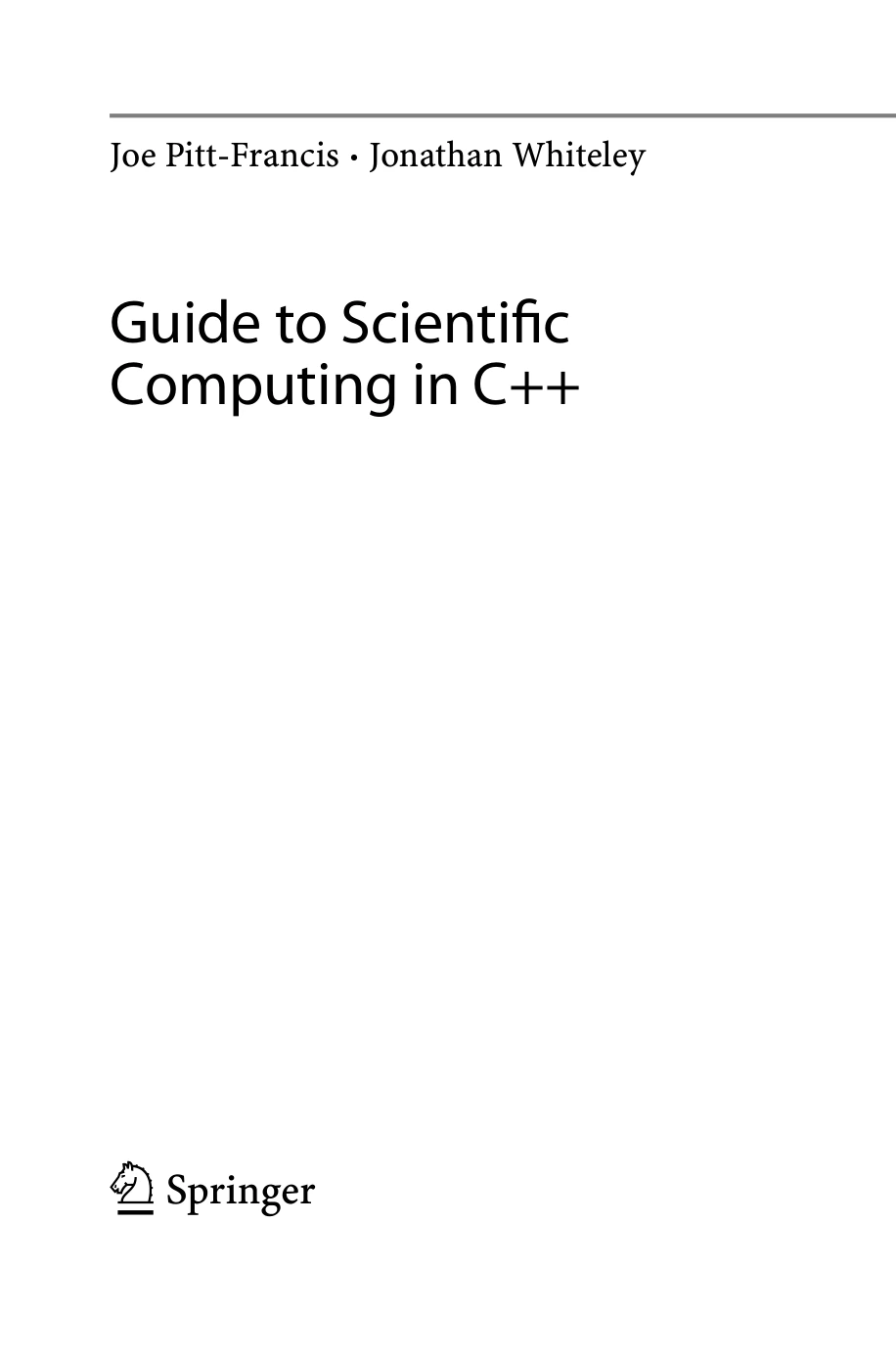
Guide to Scientific Computing in C++
Original price was: $13.99.$7.00Current price is: $7.00.

Joe Pitt-Francis
Product Specs:
- File Type: PDF
- File Size: 1.8 MB
- Book Language: English
- Total Page Count: 254
- Instant Download
Scientific programs often need to do more than calculate: they must manage data clearly, support numerical methods, and sometimes share work across processors. Guide to Scientific Computing in C++ takes those demands as its starting point, teaching the language through examples connected to scientific applications.
Joe Pitt-Francis and Jonathan Whiteley build from programming fundamentals toward the design of numerical software. The result is a practical, example-led path through C++ that keeps scientific computing in view as the concepts grow more advanced.
Start with the C++ essentials
The opening chapters cover variables, decisions and loops, console and file input/output, pointers, memory allocation, functions, and reference variables. Along the way, programming tips address common sources of errors, from floating-point comparisons to pointer use and debugging.
From classes to reusable numerical code
After establishing the procedural foundations, the book introduces classes, inheritance, polymorphism, templates, and exceptions. These ideas become more concrete in later chapters, which develop classes for linear algebra calculations and explore how object-oriented design can organize numerical libraries.
Numerical methods and parallel programming
Readers encounter vector and matrix operations, linear systems, and the design of libraries for ordinary differential equations and boundary-value problems. A dedicated introduction to MPI explains distributed-memory computing and communication, with examples including series summation and parallel linear algebra.
A practical study companion
Exercises and programming advice appear throughout, while appendices review linear algebra and other programming constructs. Selected exercise solutions are included, making the book useful for structured self-study as well as coursework.
Who may find it useful?
This guide is aimed at programmers learning to write scientific applications in C++. Basic computer use is expected; familiarity with vectors, matrices, and the Newton–Raphson method is helpful. For readers who want to connect language concepts with numerical work, its steady movement from fundamentals to applications offers a clear study route.
User Reviews
Be the first to review “Guide to Scientific Computing in C++”
You must be logged in to post a review.
Original price was: $13.99.$7.00Current price is: $7.00.
There are no reviews yet.