

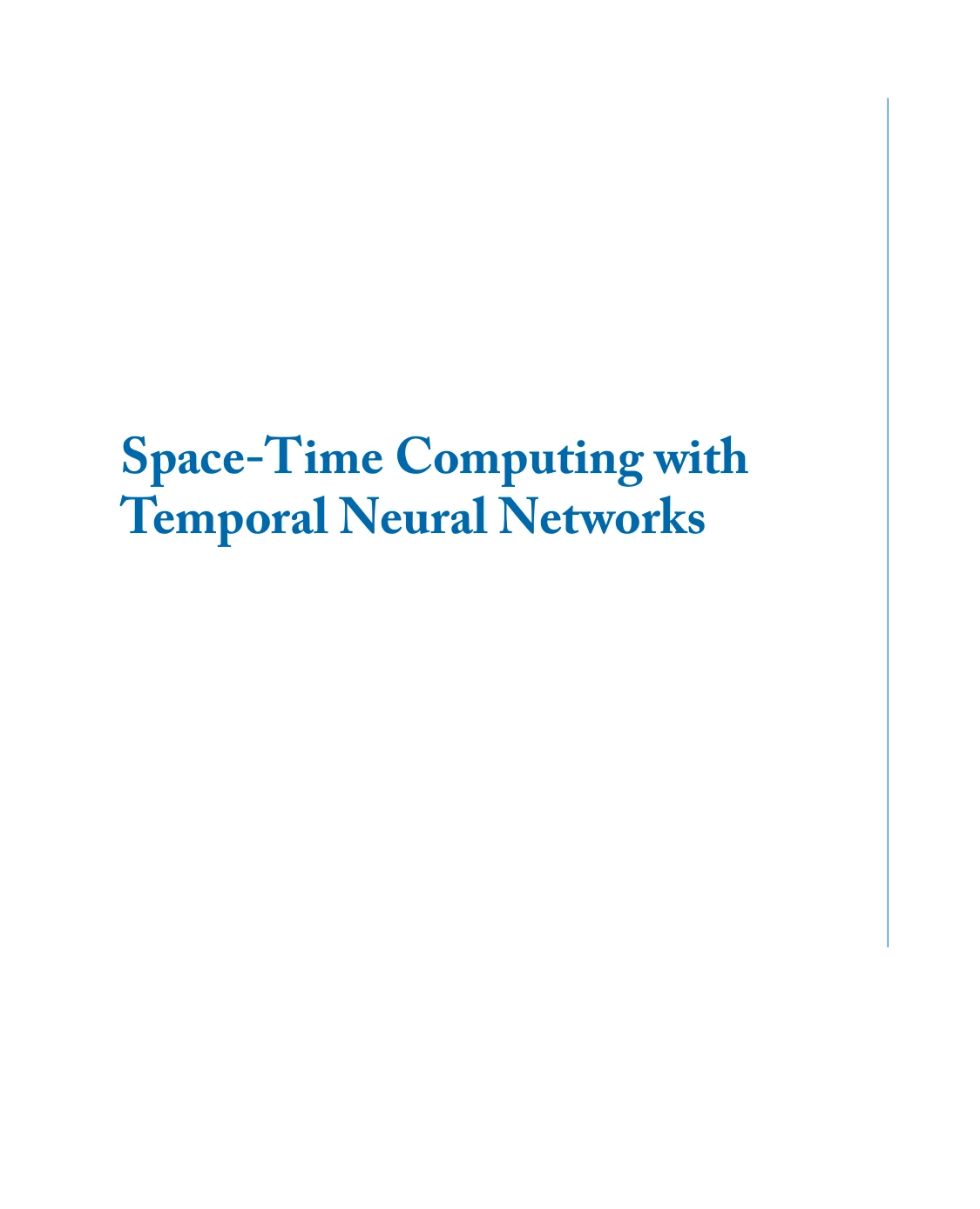
Space-Time Computing with Temporal Neural Networks
Original price was: $5.00.$2.50Current price is: $2.50.

James
Product Specs:
- File Type: PDF
- File Size: 7.7 MB
- Book Language: English
- Total Page Count: 241
- Instant Download
Beyond the Transistor: Toward Brain-Inspired Computing
James E. Smith approaches a long-standing challenge from the perspective of a computer designer: what would it take to build systems that capture the brain’s remarkable efficiency and adaptability? Rather than chasing incremental gains in conventional architectures, this book lays out a research direction grounded in the temporal behavior of neural networks.
A Computer Architect’s View of the Neocortex
The early chapters distill relevant biological features into computational and communication properties. Massively interconnected neurons exchange voltage spikes, and precise spike timing emerges as a fundamental—not incidental—element of the computational paradigm. Smith builds the case that time can serve as a freely available resource for both communication and computation, a shift in thinking with deep architectural implications.
From Spiking Neurons to Space-Time Processing
The book develops a mathematics-based computational paradigm centered on spiking neurons operating in space-time, with emphasis on time. After discussing neuron models in general, Smith selects one for detailed development. Single-neuron computation becomes a trainable process: inputs are encoded as spike patterns, and the neuron learns to identify similarities among input patterns.
Columns, Clustering, and Hierarchical Systems
Individual neurons form larger ensembles called columns, trained in an unsupervised manner. Columns collectively perform pattern clustering—mapping similar input patterns to a much smaller set of similar output patterns. This mechanism divides input patterns into identifiable clusters and forms a building block for larger cognitive systems. Smith then shows how columns can be combined into a hierarchical architecture, with ongoing study of higher-level systems described in later chapters.
Simulation as a Research Tool
Because model development depends heavily on experimentation, the book also describes the simulation infrastructure developed by the author. This practical dimension makes the theoretical framework testable and supports continued exploration by researchers.
Who Should Read This Book
Targeted at computer researchers, the text assumes no deep training in neuroscience. It would be valuable for computer architects, computational neuroscientists, machine learning researchers, and graduate students interested in brain-inspired computing. Readers should be comfortable with mathematical modeling and computer architecture concepts.
For anyone curious about where post-von Neumann computing might lead, Space-Time Computing with Temporal Neural Networks offers a thoughtful, rigorous entry point.
User Reviews
Only logged in customers who have purchased this product may leave a review.

A Guide to Desktop Linux in 2025: What Most of Your Penguin Friends Won’t Tell You
Sold by James Original price was: $5.00.$2.50Current price is: $2.50.
There are no reviews yet.