

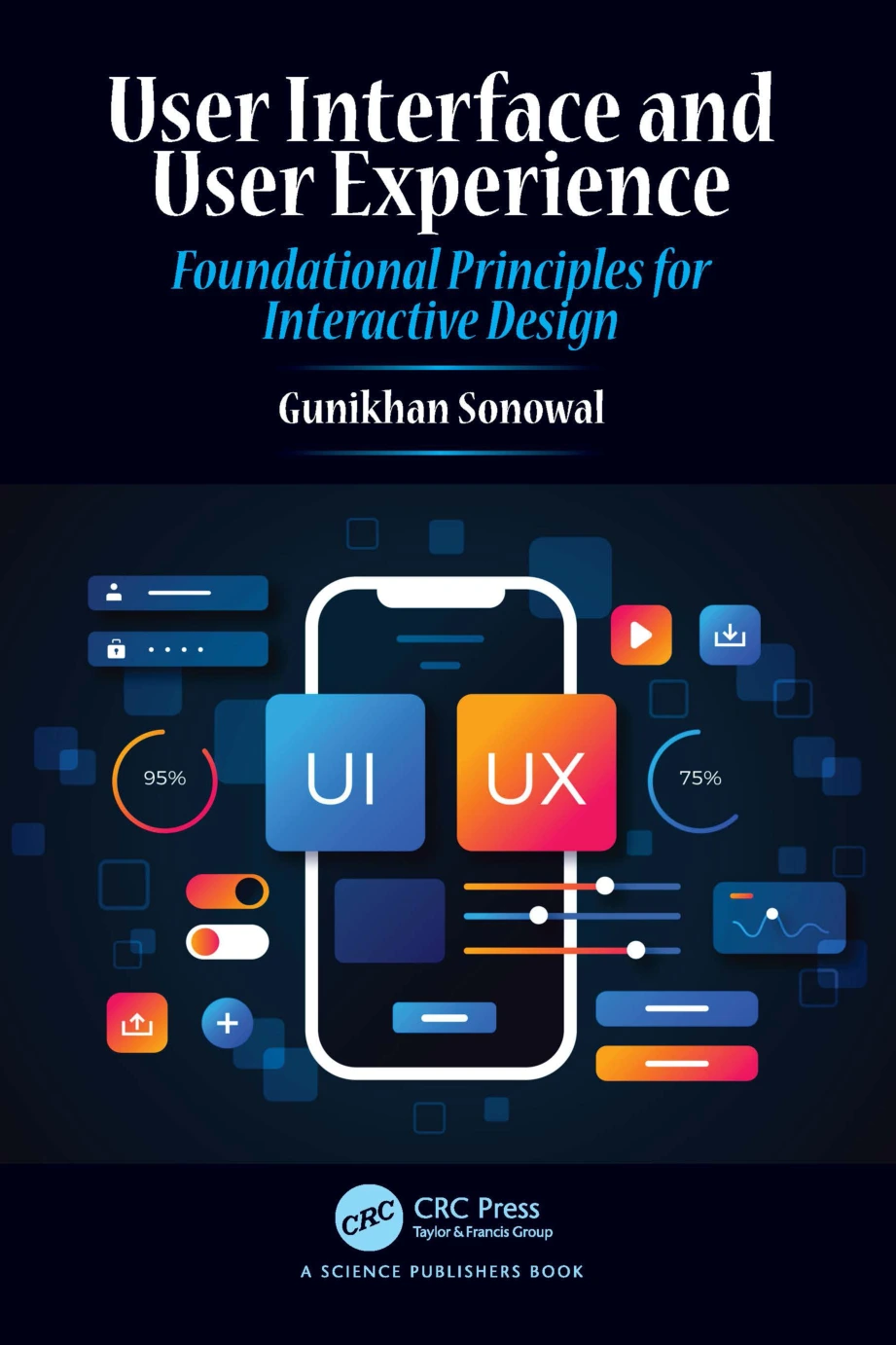
User Interface and User Experience: Foundational Principles for Interactive Design
Original price was: $5.00.$2.50Current price is: $2.50.

Gunikhan Sonowal
Product Specs:
- File Type: PDF
- File Size: 16.7 MB
- Book Language: English
- Total Page Count: 190
- Instant Download
User Interface and User Experience: Foundational Principles for Interactive Design is not a quick-fix manual of interface tips. Instead, Gunikhan Sonowal builds a systematic path from the first questions about users through the details of visual hierarchy, navigation, interaction behavior, and accessible design. The opening chapters make clear why UI and UX are distinct but inseparable practices, then immediately connect that distinction to a repeatable design process.
What the Book Actually Covers 📚
The chapters move from philosophy to practical evaluation. Early sections trace the history of interface design and introduce a ten-step process that includes product definition, research, analysis, information architecture, design, validation, interaction design, visual design, development handoff, and post-launch monitoring.
Why Psychology Is Central 🧠
A large portion of the book focuses on how users perceive, decide, and act. The author explains Gestalt principles, Hick’s Law, Miller’s Law, Jakob’s Law, Fitts’s Law, the Von Restorff effect, and the Zeigarnik effect, showing where each idea appears in real digital products rather than presenting theory in isolation.
From IA to Interaction and Visual Design
Information architecture receives detailed treatment, from organization and labeling to navigation and search systems. The interaction design chapters then use the Five Dimensions framework—words, visual representations, physical objects/space, time, and behavior—to examine how a product communicates with people. Visual design and branding are framed as tools for trust and recognition, not decoration.
Accessibility and Ethical Responsibility
The book grounds accessibility in usability and inclusion, introducing WCAG’s POUR principles. Sonowal also addresses the broader responsibility of designers to reduce barriers rather than add them—a theme reinforced throughout the later chapters and the preface.
Who Might Find This Useful?
Newcomers will appreciate the structured explanations of core concepts. Practicing designers can use the psychological frameworks and evaluation heuristics as a refresher or lens for audit work. Students in HCI, design, or computer science will find the chapter organization helpful for connecting theory with practical decision-making.
This ebook provides a coherent foundation for anyone who wants to design digital products that are not only usable, but genuinely considerate of the people using them.
User Reviews
Be the first to review “User Interface and User Experience: Foundational Principles for Interactive Design”
You must be logged in to post a review.
Original price was: $5.00.$2.50Current price is: $2.50.






There are no reviews yet.