
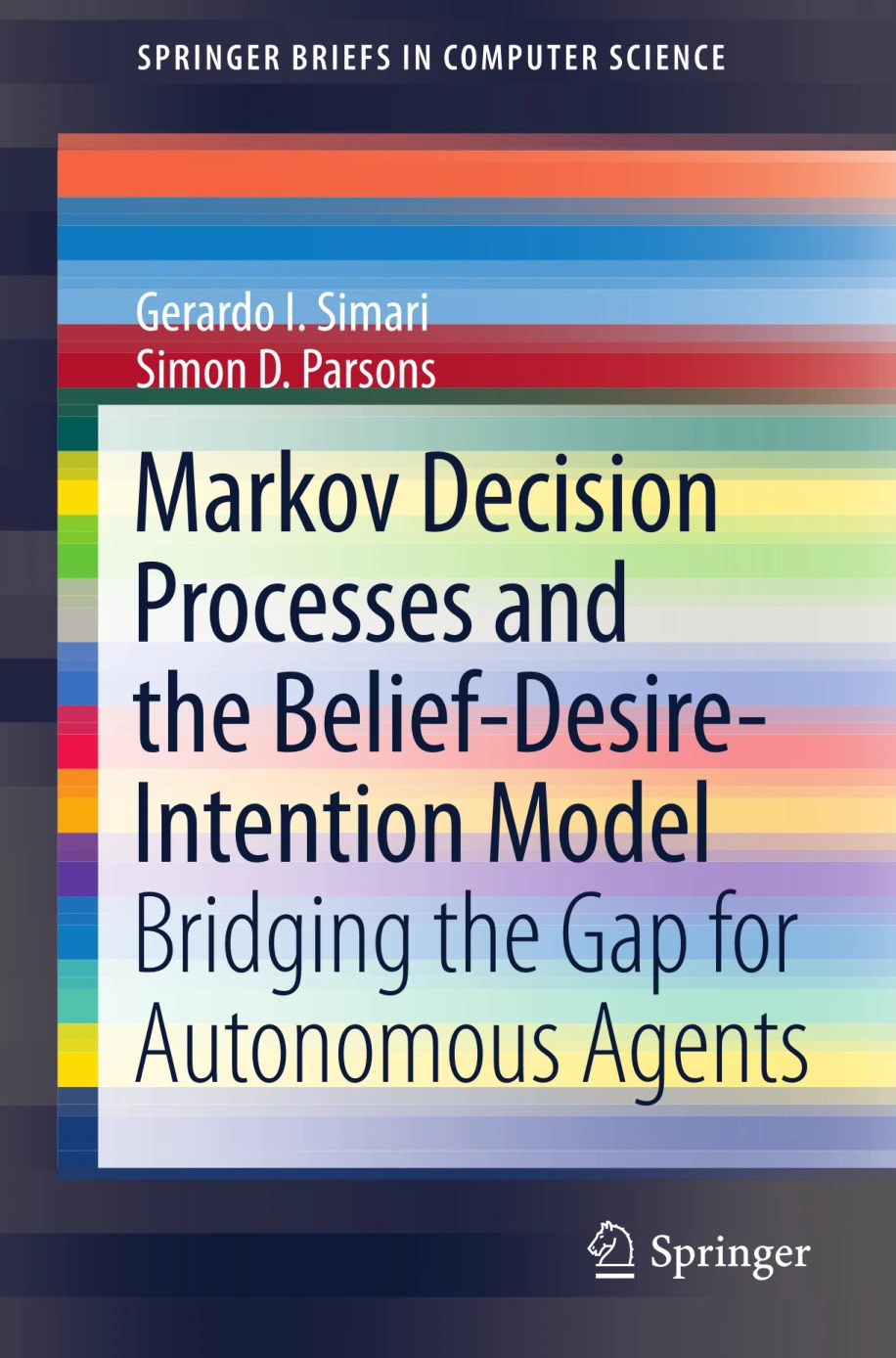
Markov Decision Processes and the Belief-Desire-Intention Model: Bridging the Gap for Autonomous Agents
Original price was: $5.00.$2.50Current price is: $2.50.
Product Specs:
- File Type: PDF
- File Size: 2.3 MB
- Book Language: English
- Total Page Count: 68
- Instant Download
Description
Bridging Two Worlds of Agent Decision-Making
Autonomous agents must make decisions without constant outside help, and in complex, uncertain environments that is easier said than done. This concise SpringerBrief examines two major approaches to that challenge: the Belief-Desire-Intention (BDI) model, which describes decision-making in terms of beliefs, desires, and intentions, and Markov Decision Processes (MDPs), a prescriptive framework from decision theory that aims at optimal choices under uncertainty.
Rather than treating these models as rivals, the authors ask a practical research question: how do they relate, and what can each reveal about the other? The result is a focused study that moves between experimental evaluation and formal comparison.
What the Book Covers
After introducing the problem of autonomy and the necessary background, the book turns to empirical comparison. Using the TILEWORLD domain, the authors test approximate solution methods and examine how factors such as dynamism, determinism, and accessibility influence performance. They also consider a larger environment, giving the experimental section a sense of scale beyond toy examples.
The theoretical side explores mappings between intentions, i-plans, and policies. It discusses potential equivalence between the models, ways to obtain more universal i-plans, state spaces and heuristics, and how to move from i-plans back to policies. The closing chapters draw out limitations and future directions, including the possibility of extending results to partially observable domains.
Who This Research Brief Is For
This is not an introductory self-help guide to AI. It is a research-oriented volume for readers who already have some grounding in artificial intelligence, decision theory, or agent-based systems. Graduate students and researchers working on autonomous agents, planning, or decision-making architectures will find the comparison useful because it connects descriptive BDI concepts with the formal machinery of MDPs. The book is also suitable for readers who want a concise, citable overview of how these two traditions can inform each other.
Why the Comparison Matters
Agent designers often face a trade-off between models that are intuitive and those that are provably optimal. BDI offers a familiar vocabulary for reasoning about goals and intentions; MDPs offer a rigorous way to evaluate policies and outcomes. By examining both, this SpringerBrief helps clarify where each approach shines and how they might be bridged in practice. The empirical results and theoretical mappings give readers concrete material to consider in their own work.
A Concise SpringerBriefs Volume
Part of SpringerBriefs in Computer Science, this book is designed to deliver a focused research contribution in a compact format. It is best read as a technical brief rather than a broad textbook. For readers who want a direct route into the relationship between BDI and MDPs, it provides a clear, structured starting point.
Only logged in customers who have purchased this product may leave a review.
Related products
-
Sale!

AI Magazine – July 2024
Original price was: $20.00.$10.00Current price is: $10.00. Add to cart -
Sale!

AI Business Magazine: May 2026
Original price was: $2.99.$1.50Current price is: $1.50. Add to cart -
Sale!

Learn ChatGPT: The Future of Learning
Original price was: $5.00.$2.50Current price is: $2.50. Add to cart -
Sale!

Operational AI with Docker
Original price was: $5.00.$2.50Current price is: $2.50. Add to cart
Reviews
There are no reviews yet.