

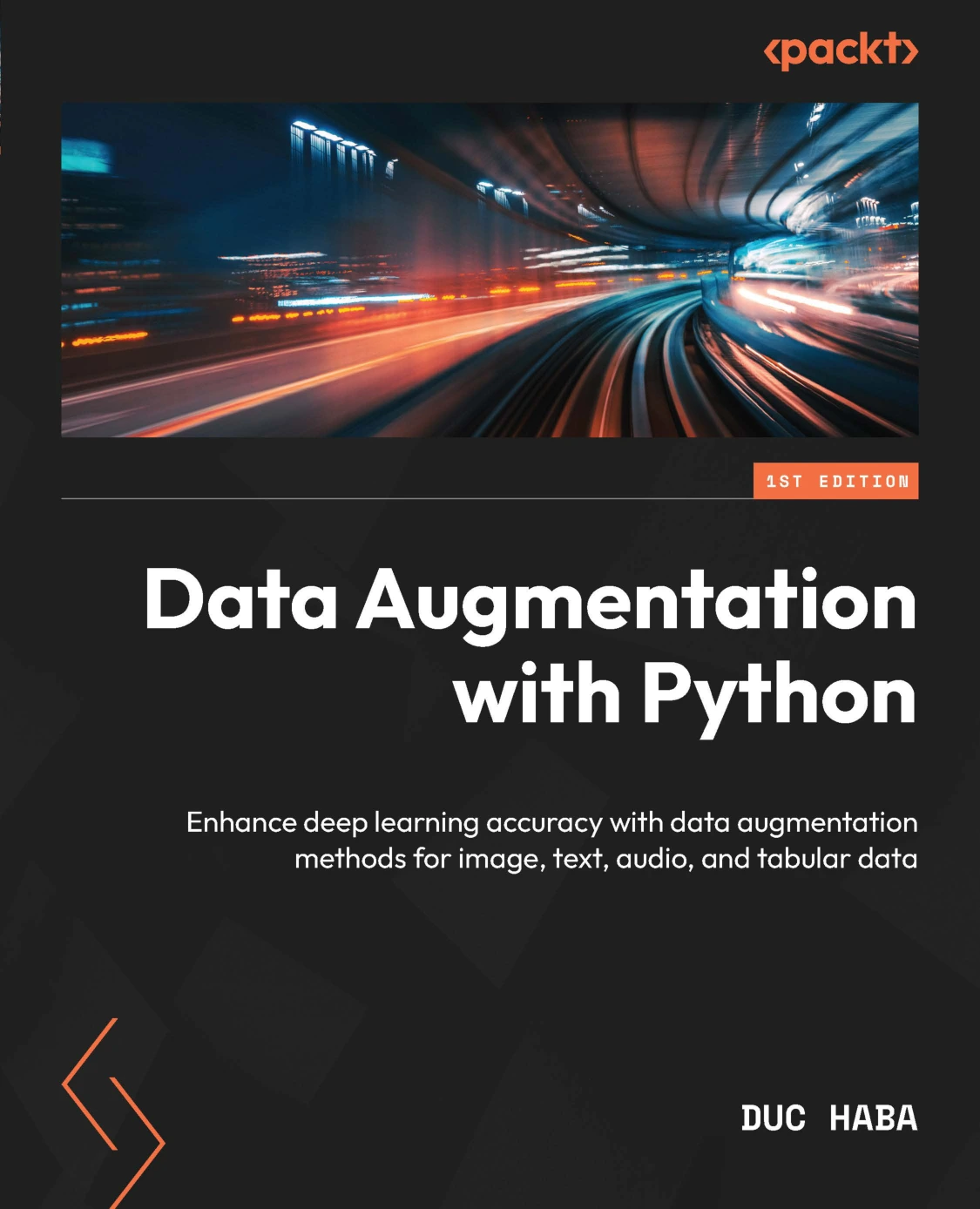
Data Augmentation with Python: Enhance deep learning accuracy with data augmentation methods for image, text, audio, and tabular data
Original price was: $9.99.$5.00Current price is: $5.00.

Duc Haba
Product Specs:
- File Type: PDF
- File Size: 43.0 MB
- Book Language: English
- Total Page Count: 394
- Instant Download
When a machine-learning project needs more examples, gathering and labeling new data may be difficult or expensive. Data Augmentation with Python examines ways to extend image, text, audio, and tabular datasets while paying attention to the biases and limitations those transformations can introduce. Duc Haba grounds the subject in Python notebooks, coding examples, and real-world data.
Four data types, one practical workflow
The book begins with core augmentation concepts, input data types, notebook setup, and programming conventions. From there, it develops techniques across image classification and segmentation, text, audio, and tabular data. The breadth makes it useful for readers who want to understand how augmentation changes with the shape and meaning of the data—not just collect a list of transformations.
From image transformations to text techniques
Image chapters explore geometric and photometric changes, including flips, cropping, resizing, rotation, and noise, alongside methods for classification and segmentation. The text section moves from character, word, and sentence augmentation to machine-learning approaches that include Word2Vec and BERT. Examples and datasets help connect the methods to practical implementation.
Consider bias as well as variety
Augmentation can add variation, but it can also reinforce or introduce bias. A chapter devoted to computational, human, and systemic biases gives this concern a place in the technical discussion. That perspective matters: a transformation is only useful when it preserves the qualities that make an example meaningful for the task.
Code alongside the concepts
Python Notebook work runs throughout the book, with object-oriented code, open-source libraries, and real-world datasets supporting the explanations. Dedicated chapters address audio and tabular augmentation, rounding out the treatment beyond the more familiar image and text applications.
Who may find it useful?
This book is aimed at data scientists and students interested in AI. Advanced deep-learning expertise is not required, but Python programming knowledge and familiarity with Jupyter Notebooks are helpful. It offers a hands-on route into data augmentation for readers who want to study the methods and work through their implementation.
User Reviews
Be the first to review “Data Augmentation with Python: Enhance deep learning accuracy with data augmentation methods for image, text, audio, and tabular data”
You must be logged in to post a review.
Original price was: $9.99.$5.00Current price is: $5.00.


There are no reviews yet.