

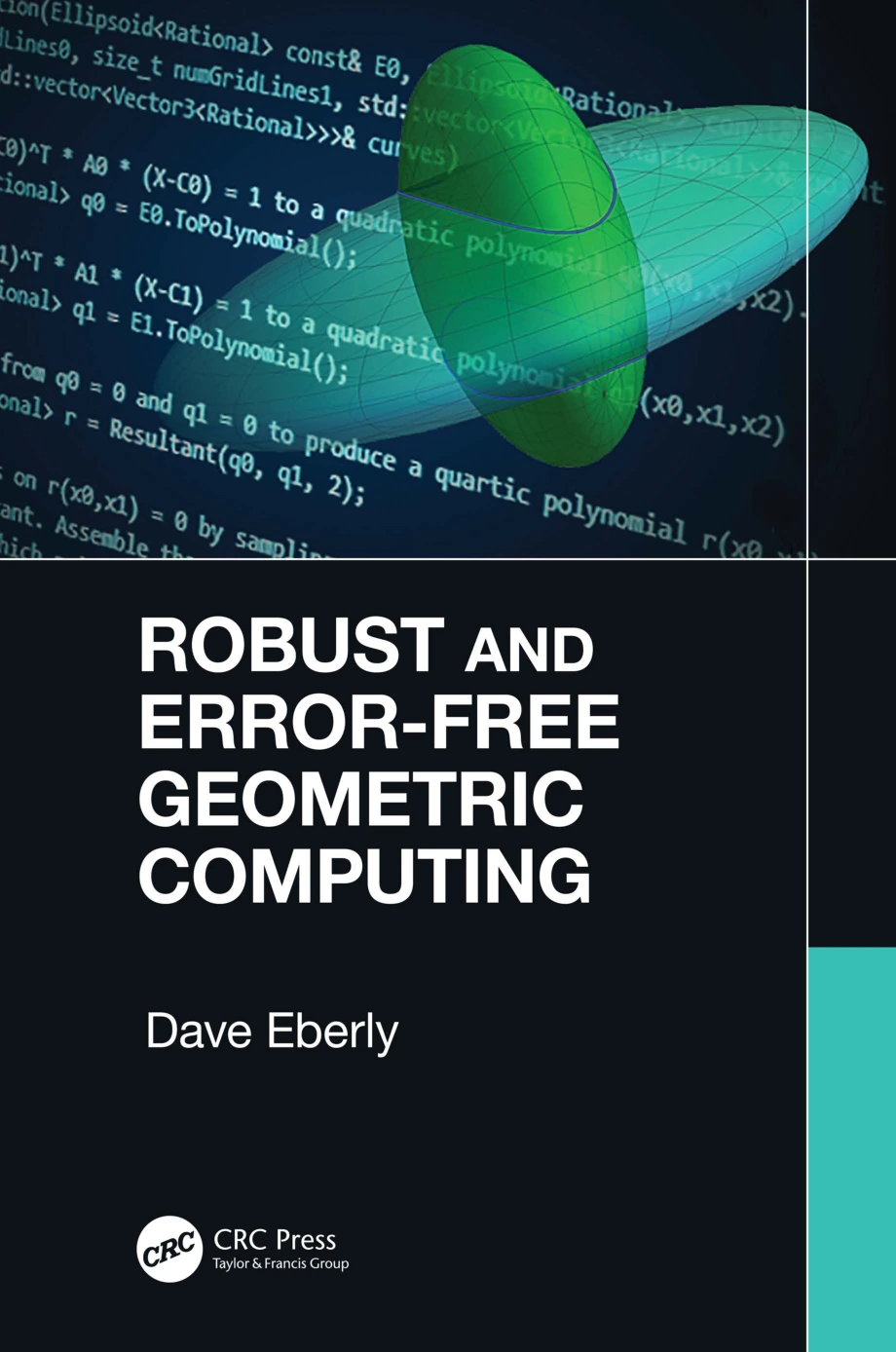
Robust and Error-Free Geometric Computing
Original price was: $5.00.$2.50Current price is: $2.50.

Dave Eberly
Product Specs:
- File Type: PDF
- File Size: 4.7 MB
- Book Language: English
- Total Page Count: 388
- Instant Download
Reliable Geometry Begins with the Right Arithmetic 💻
Geometric algorithms can look flawless on paper and still fail in production. A point that should lie on a line misses by a tiny amount. A determinant that should be zero comes out positive. A distance query returns a result that is close but not close enough. Robust and Error-Free Geometric Computing tackles those failures directly, showing how to build geometric software that behaves predictably even when floating-point arithmetic cannot be trusted.
Dave Eberly approaches robustness as an engineering discipline. The book provides a framework of arithmetic systems, explains what each system can and cannot guarantee, and helps readers select the right approach for the problem at hand.
Why Robustness Is Harder Than It Looks ⚙️
Rounding errors rarely announce themselves. They appear as inconsistent predicates, unstable intersections, and edge cases that seem to change from one run to the next. The opening chapters make this concrete through examples such as eigendecomposition for 3 × 3 symmetric matrices and the distance between line segments. By comparing nonrobust floating-point implementations with robust and error-free alternatives, the book reveals where precision is lost and how careful algorithm design can recover it.
Arithmetic Systems as Practical Tools
The book works through several arithmetic systems: floating-point arithmetic, arbitrary-precision arithmetic, interval arithmetic, and quadratic-field arithmetic. Rather than presenting them as isolated mathematical topics, it connects them to geometric operations, signs of determinants, primal queries, and accuracy problems. That structure helps readers understand the trade-offs between speed, precision, and implementation complexity.
From Distance Queries to Intersection Queries 📐
Later chapters move into methods used in graphics, CAD, robotics, simulation, and computational geometry. Topics include distance between oriented boxes, test-intersection of triangles and cylinders, separating axes for convex objects, moving triangles, line-sphere and line-box queries, line-cone intersection, and ellipse and ellipsoid intersection. Each subject is developed with an eye toward implementable algorithms rather than abstract theory alone.
Derivations That Lead to Implementable Code
Detailed derivations are central to the book’s approach. The goal is not simply to state that a method is robust, but to show the reasoning that leads to code a developer can write and test. Numerical methods, root finding, linear algebra, Lemke’s method, convex quadratic programming, and pseudocode for error-free arithmetic all appear in service of that goal. C++ rounding support is discussed where it matters, and the algorithms are presented with enough detail to support real implementation work.
Who This Book Is For
This is a technical reference for programmers, researchers, and engineers who need geometric computations to be dependable. It will be most useful to readers with a foundation in geometry, numerical computing, and algorithm design. Professionals working in computational geometry, computer graphics, game engines, CAD, robotics, and scientific computing may find the material especially relevant, as will academics and advanced students who want both the theory and the practical consequences.
Connected to the Geometric Tools Library
The book’s concepts are implemented in the Geometric Tools Library, a repository of well-tested code. That connection gives readers a way to see the ideas in working form and reinforces the book’s practical focus: robust computing is not only a matter of proving a theorem, but of producing code that can be used.
A Dependable Reference for Geometry in Practice
For readers who are tired of approximate fixes and unpredictable edge cases, Robust and Error-Free Geometric Computing offers a structured path toward more trustworthy implementations. It is a careful, code-oriented guide to making geometric algorithms behave as intended. This CRC Press title is available as a digital edition from Digital Delights.
User Reviews
Be the first to review “Robust and Error-Free Geometric Computing”
You must be logged in to post a review.
Original price was: $5.00.$2.50Current price is: $2.50.
There are no reviews yet.