

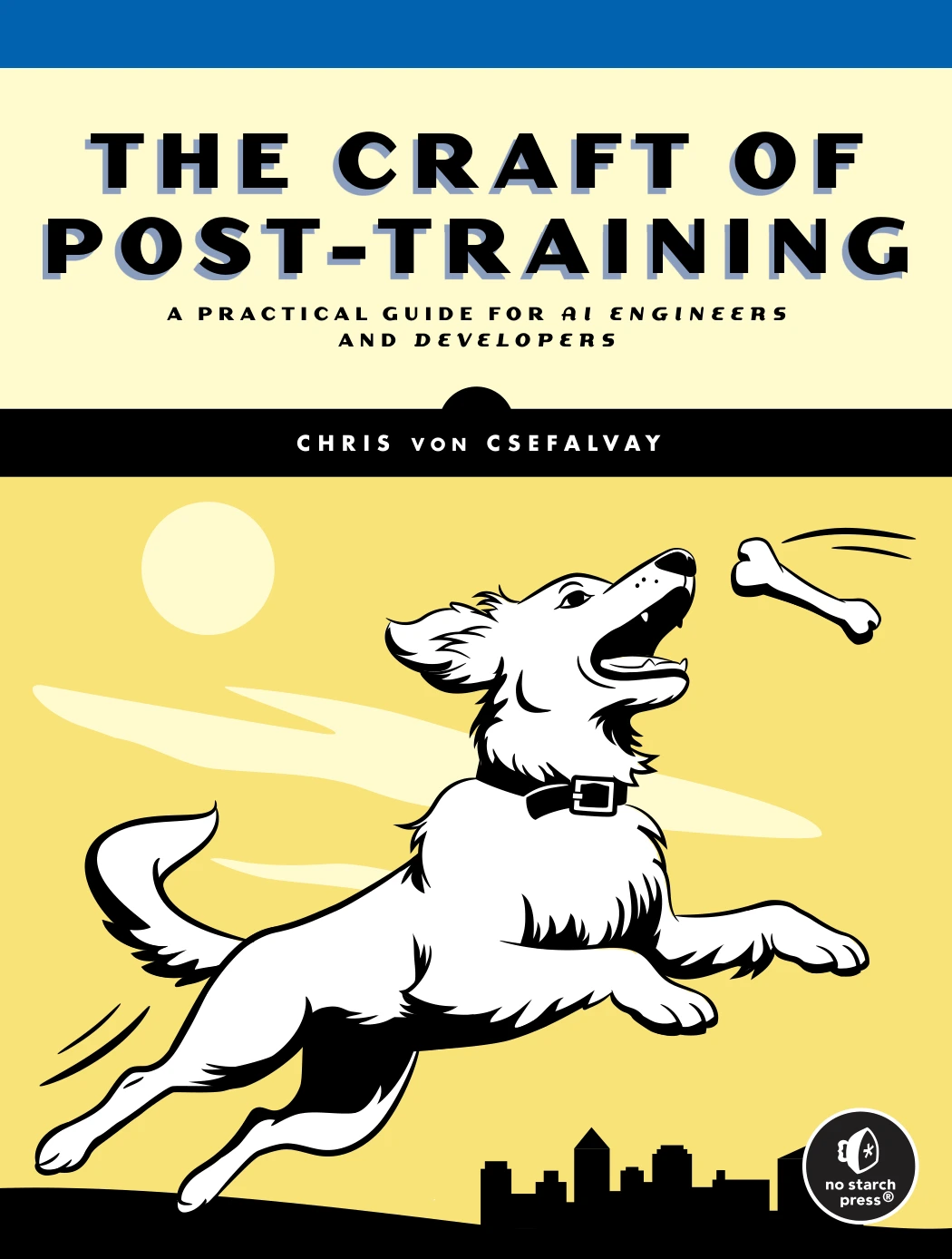
The Craft of Post-Training: A Practical Guide for AI Engineers and Developers
Original price was: $5.00.$2.50Current price is: $2.50.

Chris von Csefalvay
Product Specs:
- File Type: PDF
- File Size: 17.1 MB
- Book Language: English
- Total Page Count: 434
- Instant Download
Building the Versions of Models People Actually Use
Most conversations about large language models focus on architecture, data, or scaling laws. Yet many of the capabilities that make a model useful arrive during post-training—the deliberate process of teaching a foundation model to follow instructions, reason more carefully, use tools, and behave safely in production. The Craft of Post-Training: A Practical Guide for AI Engineers and Developers brings that often underappreciated phase into focus.
Chris von Csefalvay, a principal at HCLTech’s AI Practice with a background spanning data science leadership and applied machine learning, provides an engineering-centered tour of the techniques that turn a general-purpose model into a specialized, reliable system.
Core Techniques Without the Mystery 🛠️
The book organizes post-training into four broad parts, moving from foundations through tools, craft, and finally the frontier. Within that structure, von Csefalvay covers the methods that matter most in modern model development:
- Supervised fine-tuning as the essential starting point for instruction-following behavior.
- Reinforcement learning and its role in improving outputs through feedback.
- Preference optimization, including modern alternatives to PPO that simplify training pipelines.
- Evaluation strategies for measuring model quality beyond superficial benchmarks.
From Efficiency to Agency 💡
Later chapters address the practical realities of shipping models: quantization and compression to reduce inference costs, domain adaptation to specialize models for particular industries or tasks, and agentic models that move from generating text to taking actions. A chapter on training for reasoning capabilities examines how post-training encourages more structured, multi-step thinking, while the final section explores synthetic data, multimodal systems, and emerging directions.
What Makes This Guide Useful
The book does not simply list algorithms. It connects the choices available at each stage—what to evaluate, when to fine-tune, how to trade off accuracy against latency, and how to make models behave consistently in production. The author’s experience with applied AI across industries informs a practical tone that respects engineering trade-offs.
The inclusion of a technical reviewer from enterprise AI practice adds an additional layer of real-world grounding, while the chapter structure supports both linear reading and later reference.
Reader Fit
This ebook is written for AI engineers, ML practitioners, and developers who already have familiarity with machine learning and want a structured, practice-oriented view of post-training. It is not a first introduction to deep learning, but readers with a working knowledge of model development will find clear explanations and relevant guidance for shaping models after pretraining.
A Focused Addition to Your AI Library
For anyone responsible for turning a base model into a product that behaves sensibly—or for those who want to understand the post-training decisions behind today’s AI systems—The Craft of Post-Training offers a direct, knowledgeable companion.
User Reviews
Only logged in customers who have purchased this product may leave a review.
Original price was: $5.00.$2.50Current price is: $2.50.

There are no reviews yet.