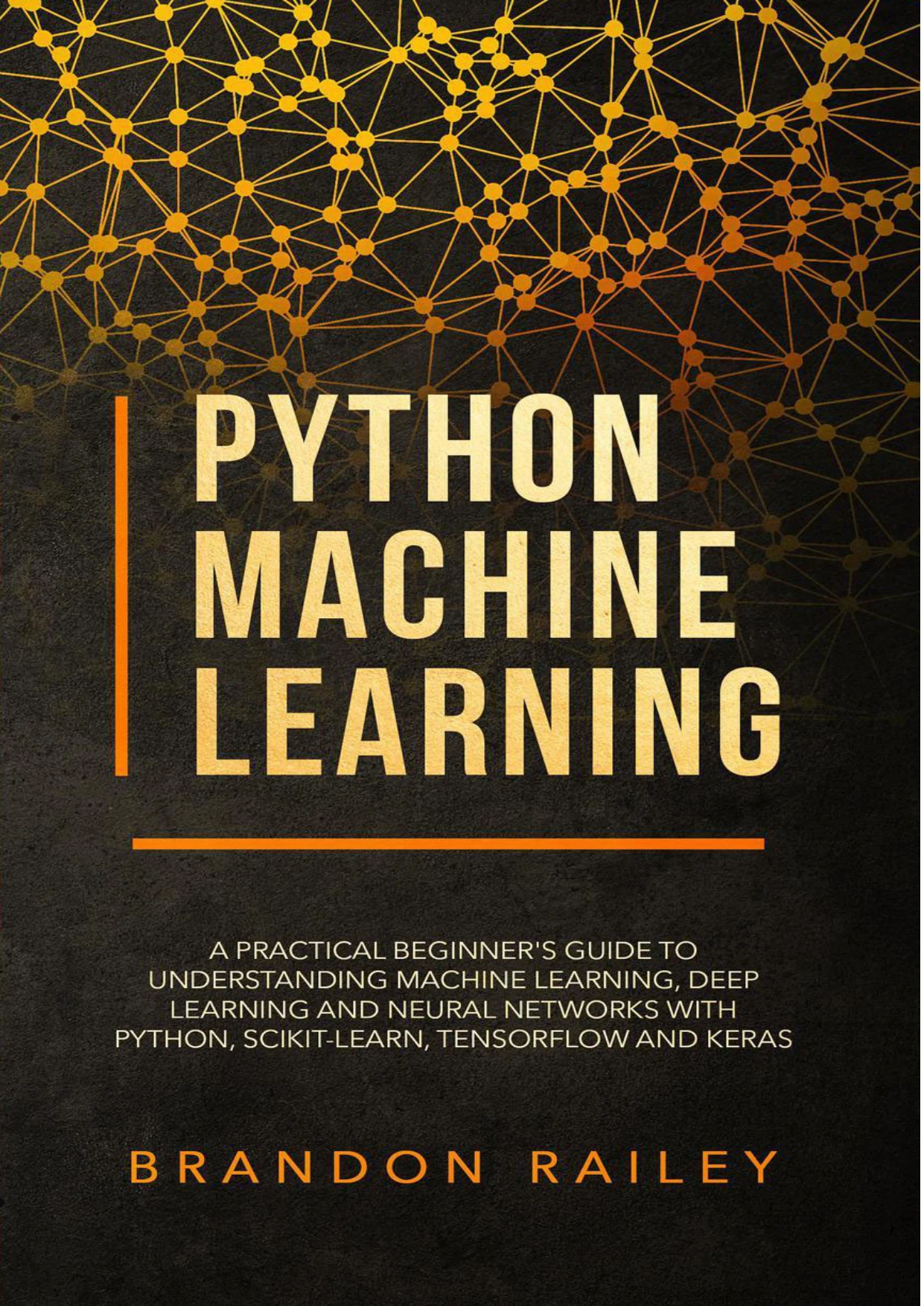
Python Machine Learning: A Practical Beginner’s Guide to Understanding Machine Learning, Deep Learning and Neural Networks with Python, Scikit-Learn, Tensorflow and Keras
Original price was: $100.00.$50.00Current price is: $50.00.

Brandon Railey
Product Specs:
- File Type: PDF
- File Size: 2.6 MB
- Book Language: English
- Total Page Count: 78
- Instant Download
Machine Learning, Explained from the Ground Up
Brandon Railey’s Python Machine Learning is written for readers who want to understand how machines learn from data before they start building models. The book begins with foundational ideas: what machine learning is, where it sits within artificial intelligence, which disciplines feed into it, and how supervised, unsupervised, and reinforcement learning differ. Examples from retail, finance, healthcare, and recommendation systems show how these methods are already used to identify patterns, flag fraud, personalize treatment, and predict customer behavior.
From Core Concepts to Neural Networks 🧠
Later chapters turn to the architecture behind modern systems. Neural networks are introduced with historical context and a practical comparison to conventional computers. Deep learning is explored through supervised and unsupervised modes. The algorithm chapter gives readable explanations of linear regression, multiple regression, logistic regression, Bayesian networks and Naïve Bayes, clustering, and decision trees, helping readers recognize the kinds of problems each method is suited to solve.
Python Skills for Data Work 💻
A substantial portion of the book is dedicated to Python itself. Readers are shown how to run Python, create files, choose identifiers, work with keywords and naming conventions, handle dynamic typing, use the None variable, work with numbers, convert data types, nest loops, and work with sequences. The material also covers installing packages for machine learning and understanding the role of Python libraries. This practical groundwork matters because machine learning code is only as reliable as the data preparation behind it.
Cleaning, Manipulating, and Exploring Data 📊
The book then moves into data handling with NumPy and Pandas. Chapters cover dropping columns from a DataFrame, changing a DataFrame index, tidying fields, combining NumPy and string methods to clean columns, using applymap() on an entire dataset, renaming columns, and skipping rows. A later section focuses on exploring a machine learning dataset. These chapters reflect a realistic view of the work: much of machine learning involves shaping and correcting data before any model can be trained.
Building a Model with Scikit-Learn
The final chapters walk through a machine learning workflow using Scikit-learn. Readers see the core steps of loading a dataset, splitting it, and training a model. A separate chapter extends the process to building a neural network with Scikit-learn. The progression is deliberate: concepts first, Python fundamentals next, data preparation after that, and then model construction. For beginners, that order can make the subject feel less abstract; for early practitioners, it offers a structured refresher.
Who This Book Is For
This guide is best suited to readers who are new to machine learning and want a plain-language introduction that still reaches into real Python tools. It may also appeal to programmers who know some Python but have not yet connected it to Scikit-learn, TensorFlow, or Keras. The book does not assume advanced mathematics, and its examples are aimed at helping readers follow the reasoning behind each step rather than simply copying code. If you want a starting point for understanding how data becomes a model, this edition provides a clear path through the vocabulary, algorithms, and Python practices that make machine learning possible.
User Reviews
Only logged in customers who have purchased this product may leave a review.
Original price was: $100.00.$50.00Current price is: $50.00.



There are no reviews yet.