

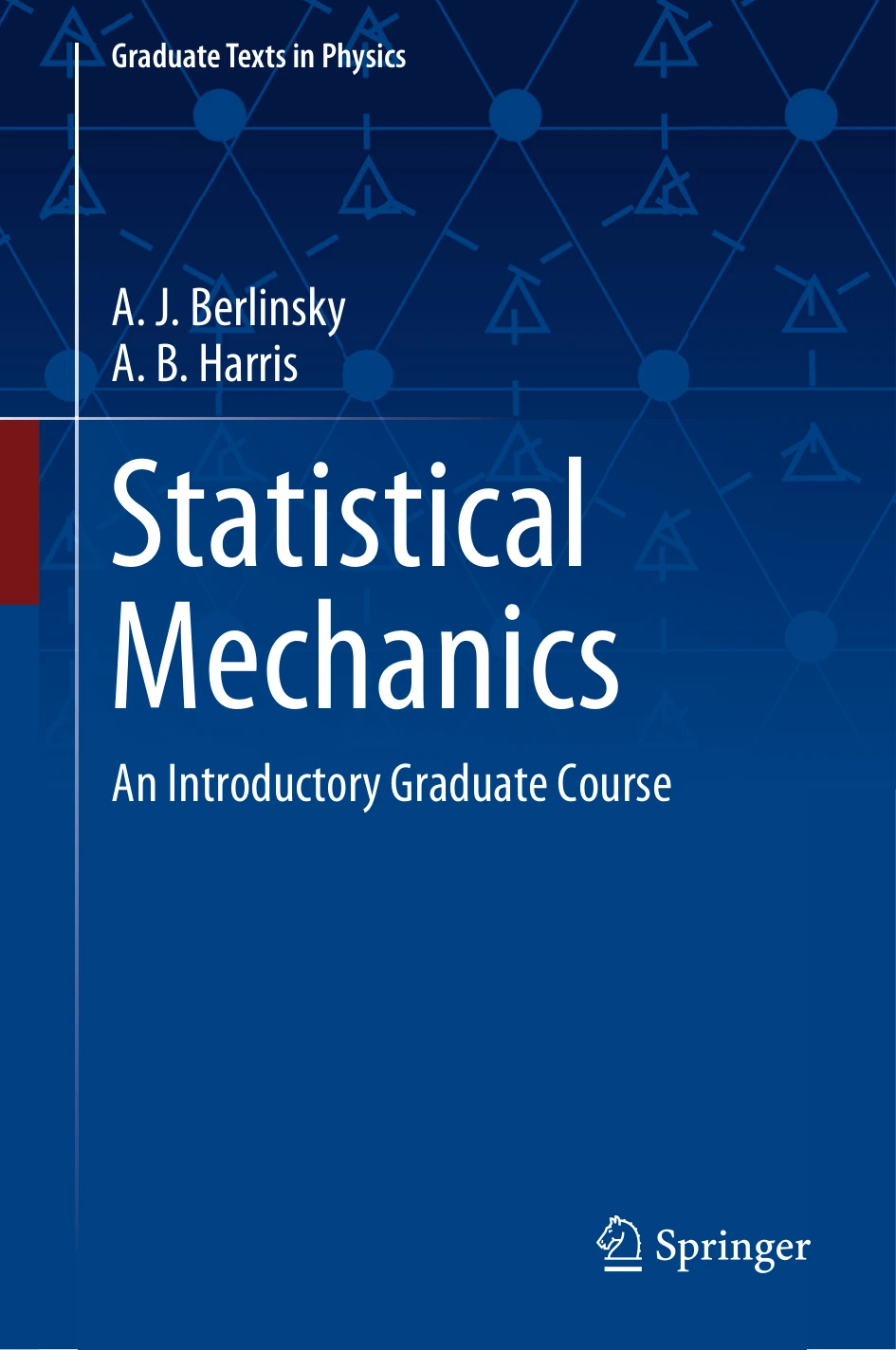
Statistical Mechanics: An Introductory Graduate Course
Original price was: $5.00.$2.50Current price is: $2.50.

A. J. Berlinsky
Product Specs:
- File Type: PDF
- File Size: 12.3 MB
- Book Language: English
- Total Page Count: 609
- Instant Download
Build a Working Understanding of Equilibrium Statistical Mechanics
This Graduate Texts in Physics volume offers a carefully structured introduction to equilibrium statistical mechanics. Rather than treating the subject as a collection of isolated techniques, Berlinsky and Harris connect the macroscopic questions we ask in the laboratory with the microscopic world described by quantum mechanics. The result is a coherent account that helps graduate students see how thermodynamics and statistical mechanics fit together as a single logical framework.
What Makes This Graduate Text Distinctive
The authors draw on their own teaching experience and research backgrounds to build the material around a few central ideas. Scaling is one unifying thread: readers encounter data collapse in the equation of state, the Gruneisen relation, and Kadanoff’s length-scaling hypothesis. Mean-field theory receives substantial attention because it is almost always the first line of attack for interacting systems, but the book also shows where mean-field theory breaks down and how more complete treatments can be developed.
Classical and quantum problems are given equal weight. The mean-field section covers not only Ising models and lattice gases but also Hartree-Fock theory for weakly repulsive bosons and superconductivity in fermionic systems. Throughout, the text includes heuristic arguments—such as the Ginzburg criterion, the Harris criterion, the Imry-Ma argument, and the Flory estimate for polymers—that illustrate how successful theoretical work is actually done.
Inside the Four Parts
The book is organized so that it can serve as the backbone of a two-semester course. Part I reviews thermodynamics and phase diagrams, emphasizing Legendre transformations and variational theorems. Part II develops the canonical and grand canonical distributions and applies them to noninteracting quantum gases. Part III is a thorough treatment of mean-field theory, including Landau expansions, coupled order parameters, and the Ornstein-Zernike form of correlations. Part IV moves beyond mean-field theory with exact solutions for the one-dimensional Ising model in a transverse field and the two-dimensional Ising model, series expansions, Monte Carlo sampling, finite-size scaling, and a detailed introduction to the renormalization group, including Wilson’s epsilon expansion and Kosterlitz-Thouless physics.
Who Should Read This Book
The text assumes a reasonable familiarity with undergraduate thermodynamics and quantum mechanics, and it is designed for students at the MS or PhD level. It is equally useful as a reference for researchers entering condensed matter physics or related areas. The problem sets include exercises that range from standard calculations to questions arising from real research, offering both reinforcement and a bridge toward independent work.
From the Classroom to Research Practice
Because the authors have made deliberate choices about scope and emphasis, the book remains focused and coherent. It does not attempt to cover nonequilibrium transport, biological systems, or every advanced topic, but what it does cover is treated with clarity and depth. For a graduate student building a serious foundation in equilibrium statistical mechanics, this digital edition provides a convenient and searchable way to study the material at your own pace.
User Reviews
Only logged in customers who have purchased this product may leave a review.
Original price was: $5.00.$2.50Current price is: $2.50.


There are no reviews yet.